
 Chapter 4
Kruger
National Park
And return
March 17, 18, 19, 20
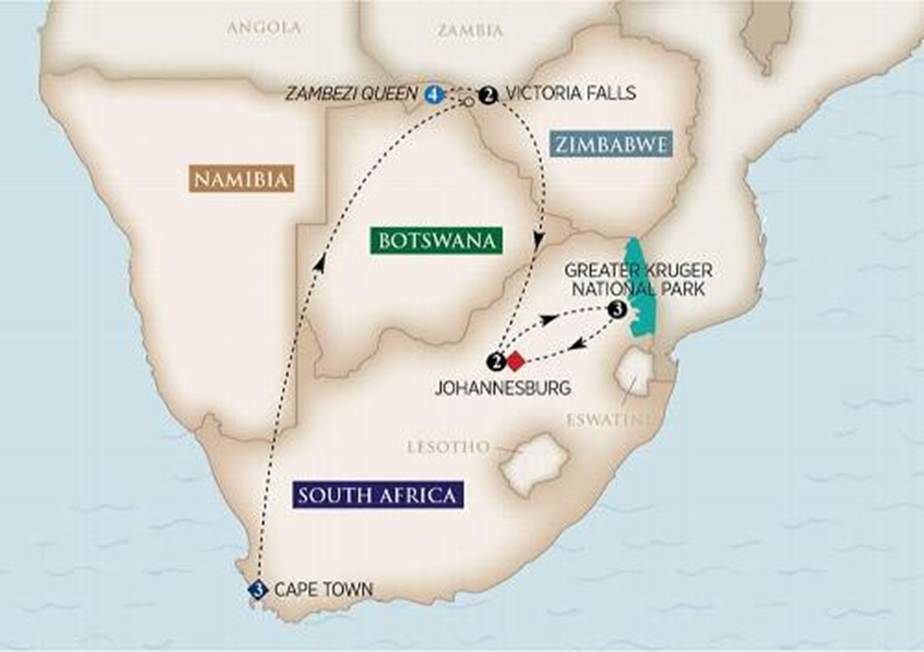
From Johannesburg to Kruger Park
Tuesday, March 17: Johannesburg to Kruger Park
We had a slightly early start this morning, with breakfast at the hotel, then into the bus for the 30 minute ride to the Johannesburg airport. The “group check-in” seemed a little disorganized, but we were soon checked in and sitting in the departure lounge for our 10:30 flight to Hoedspruit. Yes, that is the name of the town closest to the Kruger park, and don’t ask me how to pronounce it. It is not even an hour flight and it was a nice day for flying. I did notice one interesting sight as we were starting our descent into Hoedspruit: a river that appeared to be overflowing its banks.
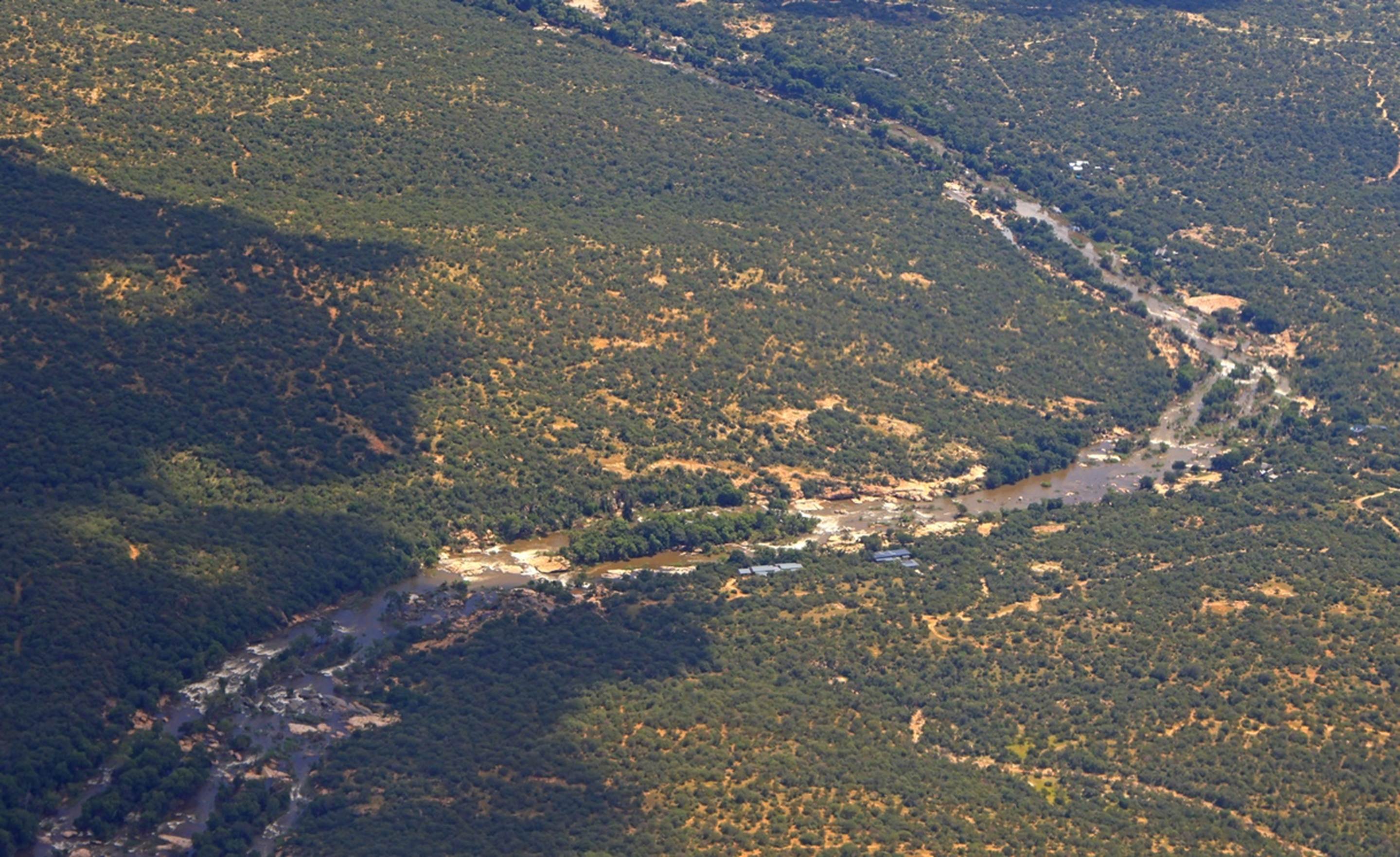
The river appeared to be at flood stage.
As we would find out, this area had been having a very, very wet summer rainy season. Every thing and every road was wet. We were told that the day we arrived was the first day they had not had significant rain in two weeks. Our safari guide/driver said his house had been flooded three times this summer, and it had never been flooded before. This abundance of water would significantly flavor our visit, but definitely not destroy our enjoyment.
On our approach and landing, I thought that this seemed to be a very large and extensive airport, with long runways and built to handle much heavier aircraft than what would normally serve such a small city. Then I remembered that Kirsten had said this airport was built as a military field long ago and, when it became obvious that tourism was rapidly growing in the area, a small terminal building was added and the field is now a “mixed use” airport. It took a while to get the baggage out but then our driver from the Tintswalo lodge loaded our bags into a trailer and the 12 of us climbed into the van.
Wait a minute, “12 of us”? What happened to the 24 that were on the Zambezi Queen? About half the people who were on the Queen were actually on a different itinerary and tour: they took a different flight out of Johannesburg and were headed to a different adventure in Kenya. We also “lost” our AMA Waterways tour director/manager, Kirsten, as he headed back home to Cape Town. We would be by ourselves (and the Tintswalo staff) for the next few days.
The ride from the airport to the Tintswalo Safari Lodge was a little over an hour with the first 45 minutes on good paved roads and the last 20 minutes on dirt and mud “dirt roads”. It was shortly after we left the paved roads that we had our first significant animal encounter: a small herd of Zebra. We would see quite a few zebras during our visit and learn some surprising facts about them.
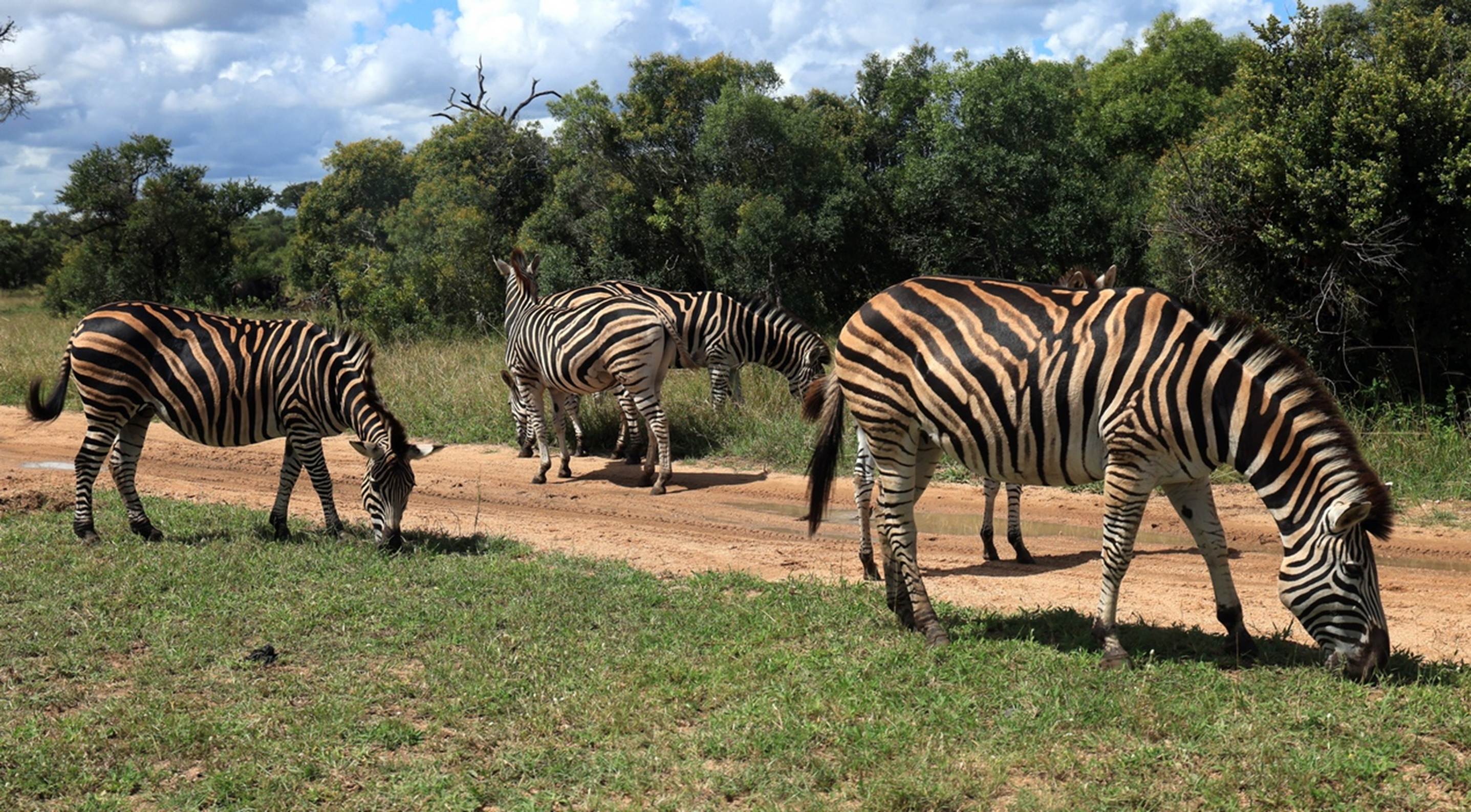
Our welcome committee mostly ignored us.
We finally did arrive at the Tintswalo Safari Lodge and it was a unique place.

The Tintswalo entrance “gate”
The staff met us with many smiles and led us into the main building across elevated walkways that connected all parts of the lodge. I suspect the walkways were partly to avoid the wet grounds and also to provide some separation from the animals that wander around the area. While the Rhino in the photo below is just a metal sculpture, Impala and Kudu Antelope did come into the village several times and the staff asked that we get one of them to escort us to our “rooms” after dark as they occasionally do get less friendly animals.
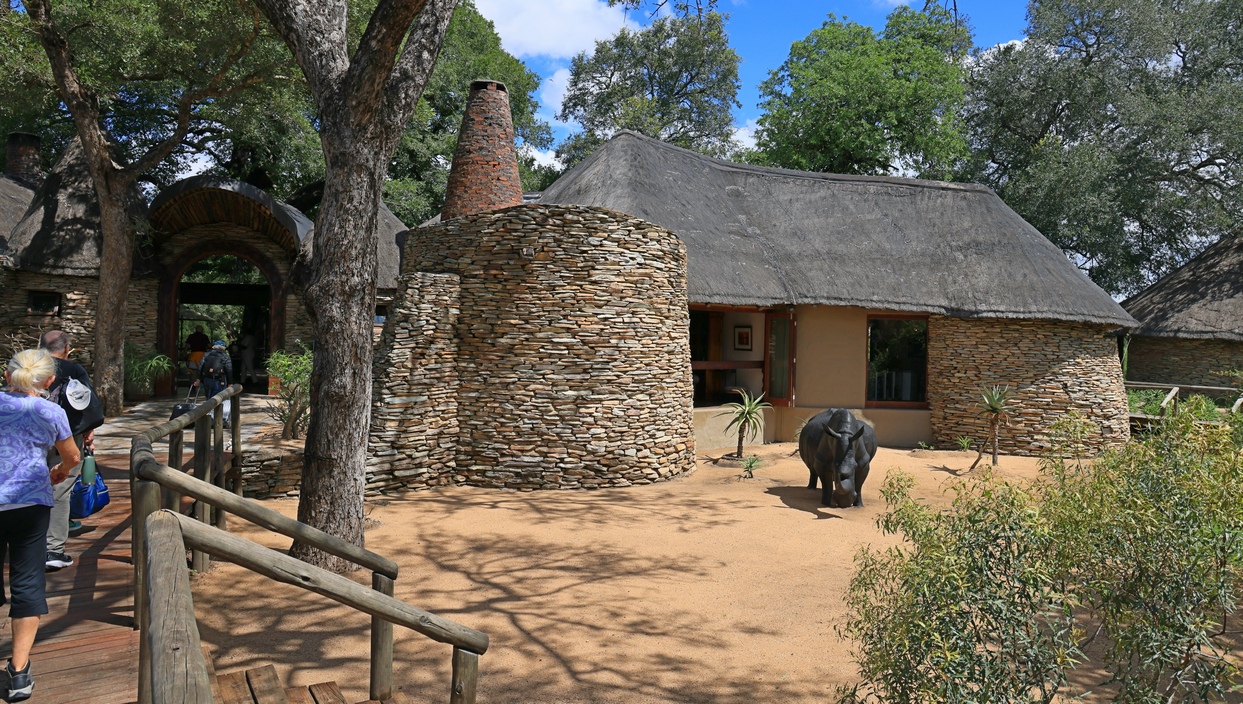
Unfortunately, this was the only Rhino that we saw.
Since we didn’t have anything to eat on the short flight and by now it was almost 2:00, the first order of business was lunch. A small but very nice buffet was laid out and we enjoyed the meal on their raised patio. This is where we would have almost all our meals at Tintswalo.

This is where we had most meals at the lodge.
After lunch, we were taken to our “rooms”, but using the “rooms” term is a bit deceiving: they were very nice lodges. Each lodge was slightly different, but I’ll provide a short description of ours. The buildings are all circular, with multiple circular sections to a lodge and all had actual thatched roofs. From our entry door, you enter the dining room/entry which had a table & chairs and several storage units. From there you go into the sitting area, which looks out over a large deck with a plunge pool.
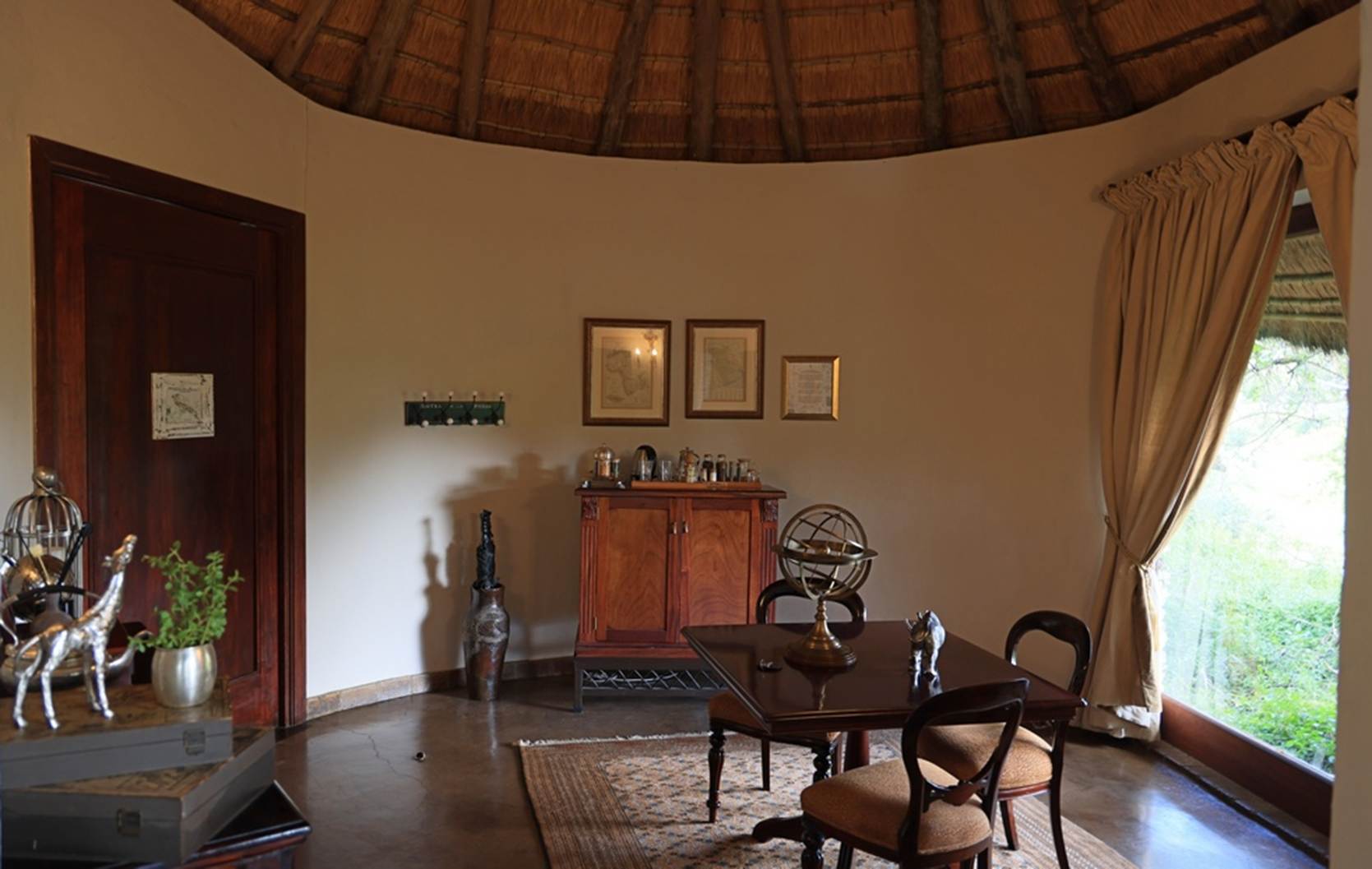
Entry (Dining room?)

The Sitting area
The back half of the sitting room had the 4-poster bed and behind the bed was a closet and storage spaces. Beyond this room was the bathroom with a large tub in the middle, double sinks against the back wall, and a shower along the outside wall. You can see the blue tile shower in the photo below: notice that there is a glass door to the outside and there is no provision (blinds, drapes, etc.) to cover that glass.

The “bedroom”, a 4 poster bed

The bathroom
A couple of ladies in the group were not especially happy about that glass door, but it really was not a problem: there was no way anyone could get to the area outside that door. Each of the lodges were separated from the other lodges by more than 100 feet of rather dense trees and undergrowth. You could not see another lodge, or any structure, from a lodge: they were very isolated. I do understand that a couple of small monkeys did appear outside one lodge, however, and this relative isolation was the reason we were to be “escorted” to and from our rooms after dark.

Looking over the deck and plunge pool
You could go out on your deck and enjoy the plunge pool in complete privacy. Unfortunately, the water in the pool was a bit too cool for my tastes.
The staff had told us that there would be a “high tea” (tea and cookies/pastries) at 3:30 every day and then the afternoon animal safari would start about 4:00. We settled into our lodge and, although we were certainly not hungry, we had to go check out the high tea. About 4:00 we headed to the raised boarding platform for climbing into the 4x4 vehicles. These were much like the 4x4s we rode in during our land safari at the Chobe Park a few days previously. We ended up with Barbara (the serious birder) and her husband John, and the two “solo” people, Dana and David, with us in our 4x4. Susan and I ended up in the rearmost seats because we were probably the ones most capable of climbing up and down when getting on or off the 4x4s. This is significant because the rearmost seats also get the roughest (bounciest) ride and we did get bounced around a lot. We would keep these vehicle “assignments” for the duration of our stay here.
Since we had “Barb the Birder” with us, we generally stopped to look at birds more than the other vehicle did. We did see a lot of interesting and colorful birds.
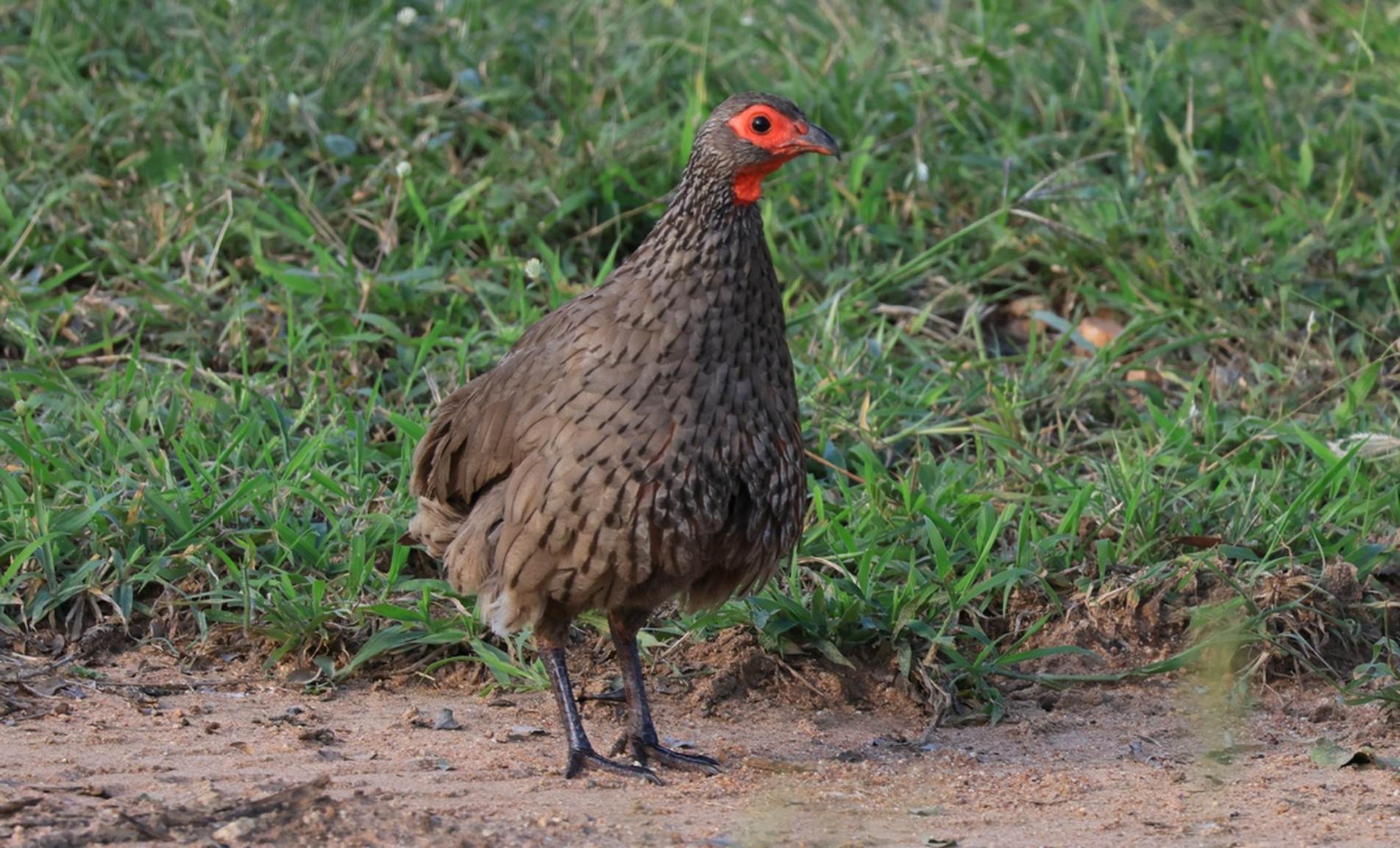
I looked, but could not find the name of this bird.
As I mentioned, we did see plenty of Zebras. One of the interesting facts: zebras actually have white stripes, not black stripes. Their skin is black, so if you shaved the hair off, they would be all black. Therefore, the stripes are white: so said our driver/guide, Ray.

Are the stripes black, or white?
We soon came across a small herd of Wildebeests. I say small because in some areas these animals will gather in herds of tens of thousands when migrating from one area to another. Ray said “They’re dumb… they’re just dumb”. He didn’t think too much of them.

A few Wildebeests
We definitely came across enough interesting birds to keep Barb busy and happy. There were very colorful birds in the area.

This Blue Eared Starling was beautiful
The Southern Ground Hornbill was definitely striking, but not exactly beautiful. They are actually somewhat rare and Barb was very pleased to have seen (and photographed) one of them on our first evening.

Southern Ground Hornbill
The next topic is a bit sad. We got word of a male lion lying in the tall grass next to a tree, so we went to take a look. Ray identified this lion as the current alpha male of the local pride of lions but he appeared to be injured. He was lying there breathing and occasionally moving a little, but he did not look good. Ray said that the other male lions (there were at least 3) probably ganged up and attacked him, badly injuring him. If hyenas or wild dogs found him in this condition, they would probably attack and kill him. We left him to allow nature to take it’s course, but we will see him again.

The injured alpha male lion
A short distance away we came across another lion, this one a female, and Ray said it is very possible that she had been “visiting” the injured lion. This lion appeared a bit restless: she would lay down for a while, then get up and walk down the road a short distance, stop, and come part way back. The amazing thing to me is that she basically ignored the two or three 4x4s along the road and walked around them like they were just trees in the way.
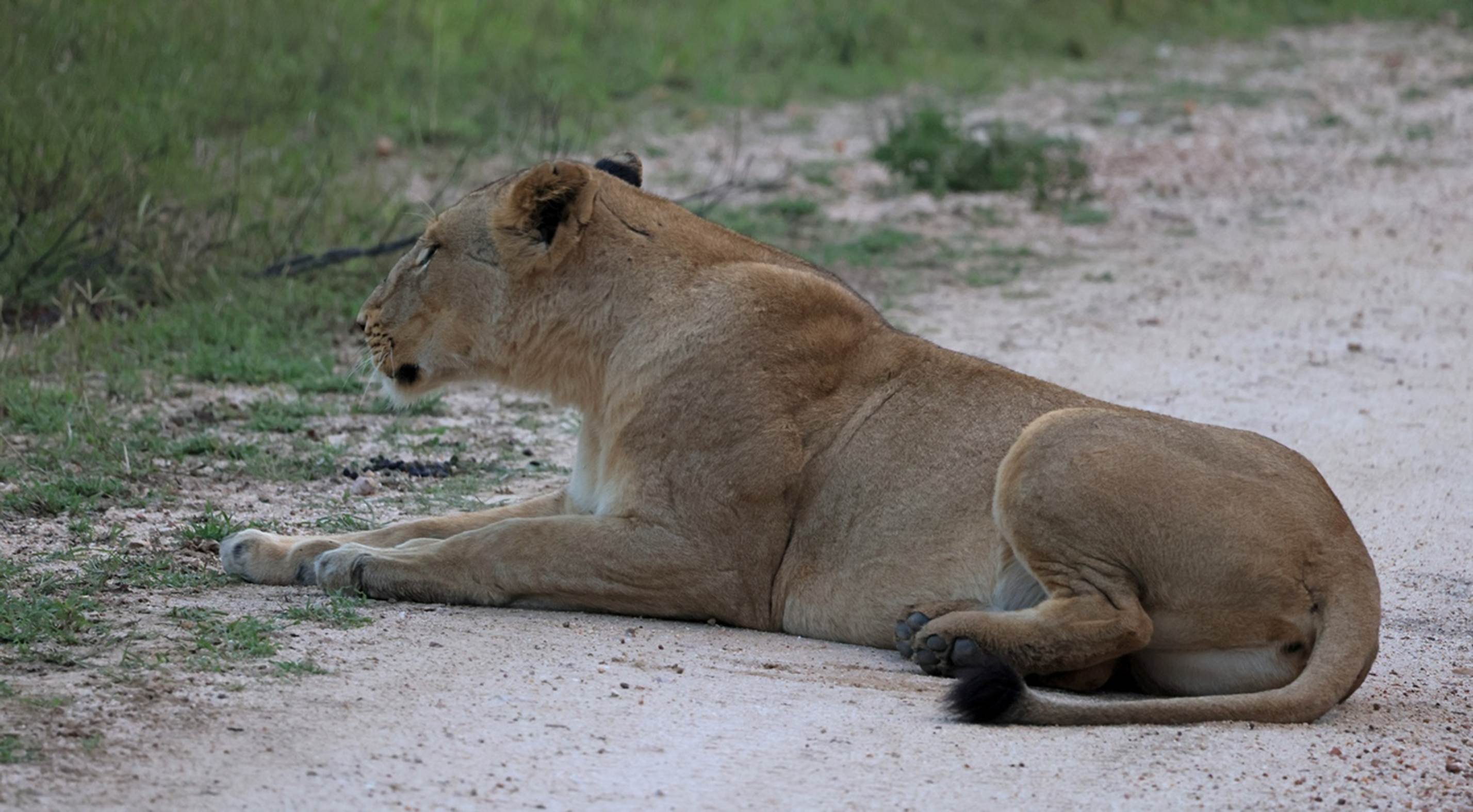
A lion in the road
Ray said that she is probably looking for other members of her pride, probably the other females. Watch this video of her walking and calling to the other lions. It was a sad moment, first because of the injured male lion, and then because of the female unsuccessfully trying to locate her family.
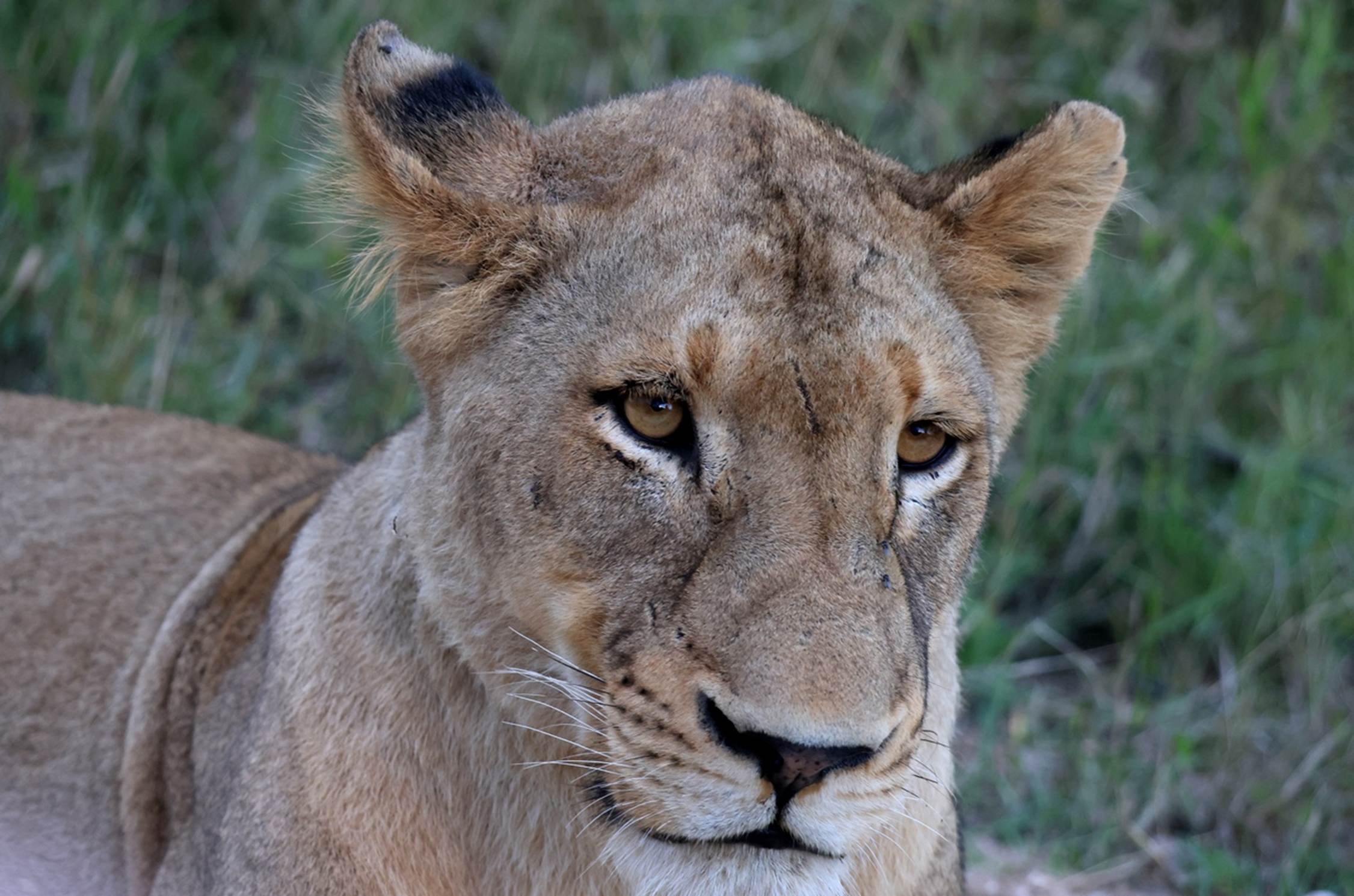
She is a beautiful animal
We drove a little further and then, coming around a corner, there is a blazing fire in a decorative fire pit with chairs around it, lots of food on one table, and drinks on another table. We all said “Wow!”. So, of course we piled out of the vehicle, grabbed a drink and some food, and found a seat around the fire.
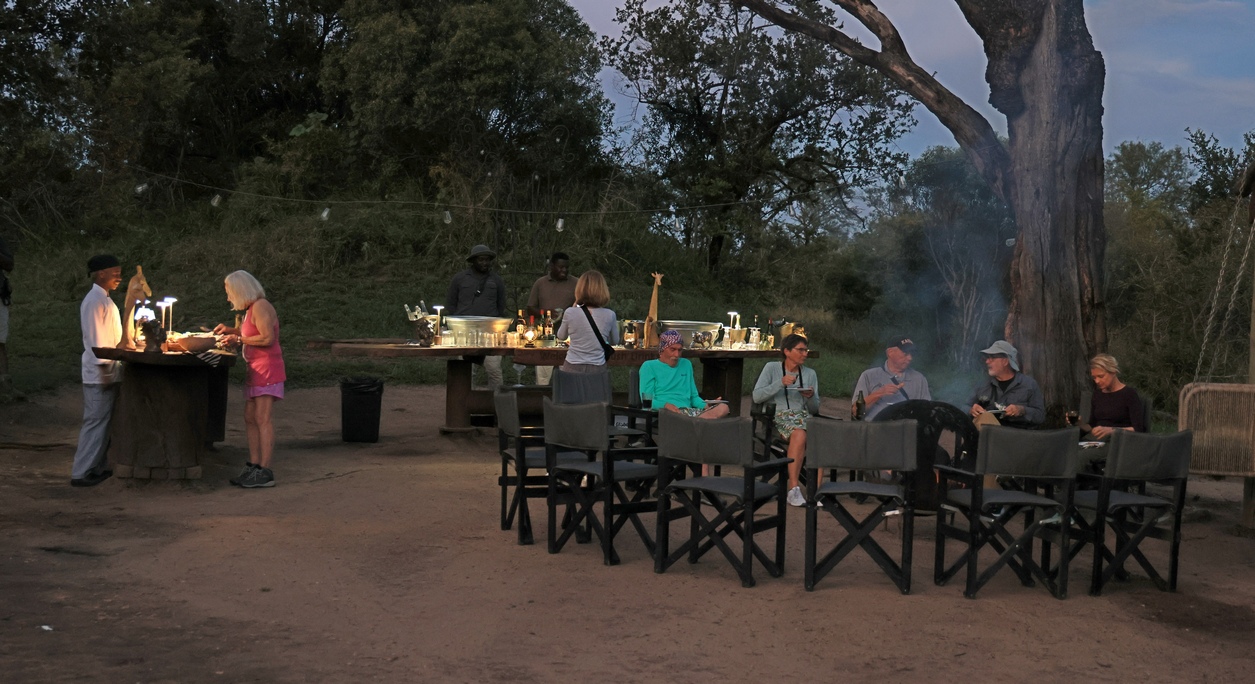
A definite surprise in the woods
There was plenty of food: even after almost everyone had been through the serving line, there was still a lot left, as you can see below.

And, this was just appetizers!
We all sat around the fire (hmmm, fire keeps the wild animals away, right?) munching on delicious food and enjoying wine or about any other drink. It was rather unique.
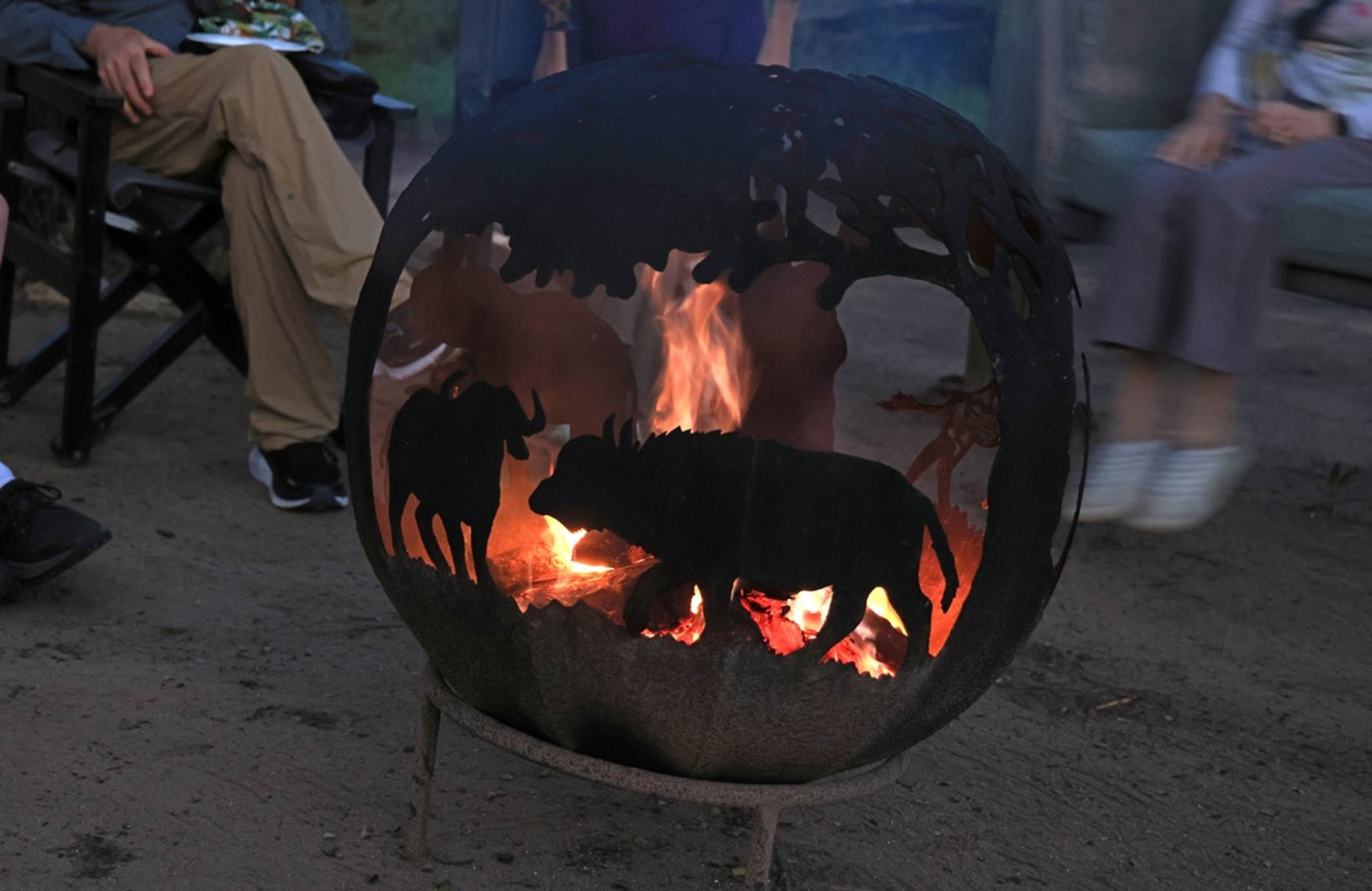
Notice the animal shapes on the fire pit.
We enjoyed the beautiful evening for a while and loaded back up into the 4x4s, heading back to the lodge where we would have the actual dinner. Our stop in the woods was just for the starters, we had another meal out on the deck. Quite a day.
Wednesday, March 18, 2026: Tintswalo Safari Lodge, day 2
First, a quick explanation/clarification. Although I have been referring to going to the Kruger National Park, we were not really in the park. Tintswalo and several other similar safari lodges are located in a large privately owned reserve that is adjacent to and connected to the park. The animal population is essentially the same and all animals can roam freely across, back and forth, between the reserve and the park, so there is really very little difference.
Today we started our standard safari schedule: wake up at 5:00 AM, have coffee and pastries at 5:15, and start the morning animal drive at 5:30. The most interesting animals get started early so we have too also. After the morning drive, we’ll have a late breakfast, relax until the 1:30 lunch, then the 3:30 “High Tea”, and about 4:00 we head out for the evening animal drive, followed some time later by dinner.
This early morning drive was not real productive with limited sightings of the most interesting animals. We will have a very minor encounter with a leopard, but I’m getting ahead of myself. Of course, there are always zebras around and they make for interesting photos. The zebras below were being somewhat frisky this morning, with one of them running and kicking and generally stirring up the others.

Always some zebras around
If the animals are not especially interesting, we can always turn to the birds, and there were several of interest. The Southern Yellow Billed Hornbill (below) seemed to be watching us as much as we were watching it.

Southern Yellow Billed Hornbill
And, of course, we saw some of the same birds here as we saw along the Chobe river, such as the cute and colorful Lilac Breasted Roller (below).
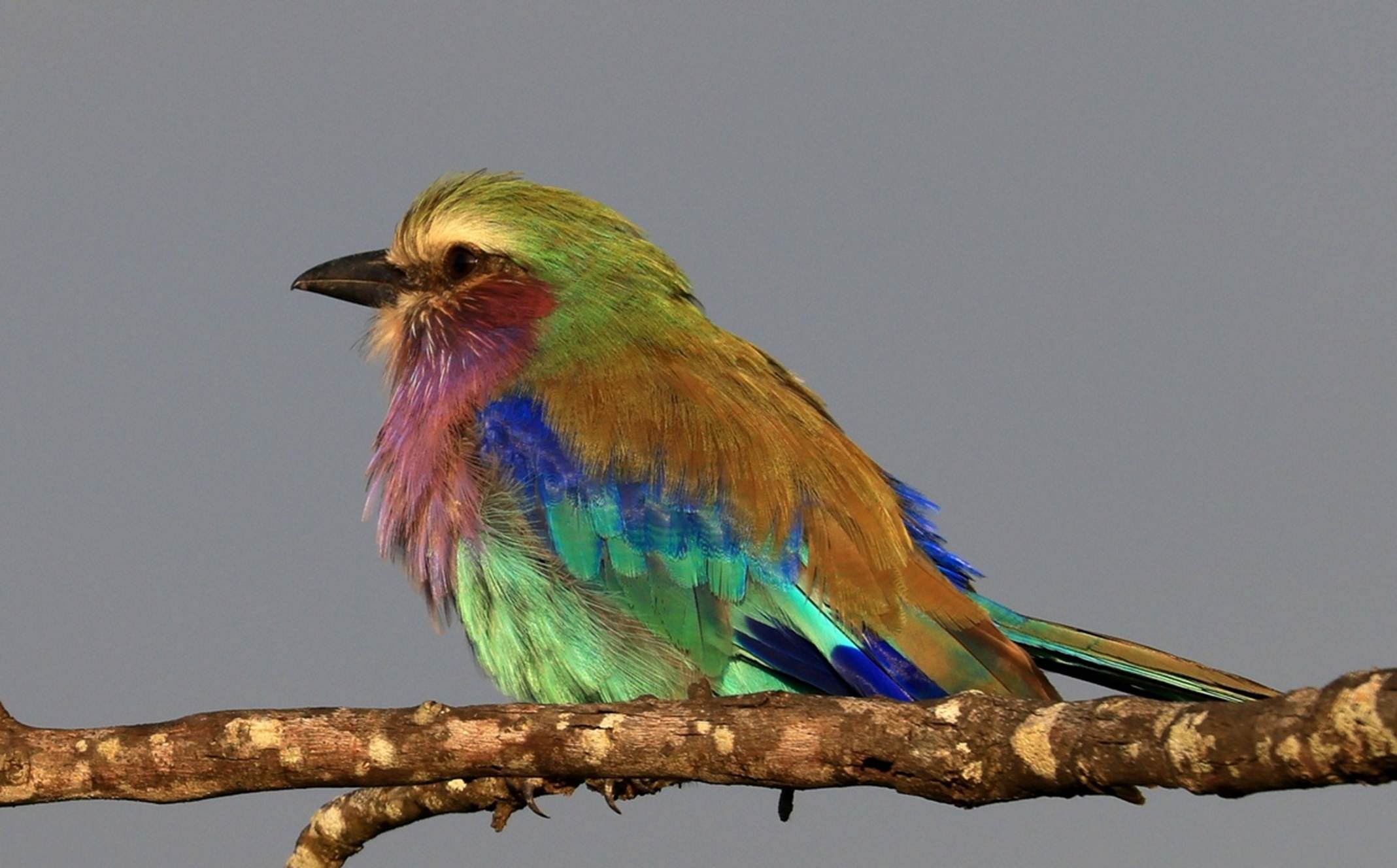
Lilac-Breasted Roller
As I mentioned previously, there had been a lot of rain in the area and many of the roads were flooded. You will see more examples, but the photo below is a good sample. Our 4x4s had a seat welded onto the front left bumper for a “tracker” to ride on and hopefully spot animals and animal tracks but I think our tracker kept busy mostly mapping out the best route through the flooded roads.

Sample of a typical road
At one point we got word that another vehicle had spotted a leopard not far from us. Leopards are rare and everyone wants to see one, so we headed in that direction. When we got there, the guide in the other vehicle said the leopard had been spotted going into some very dense brush about 200 feet away. Everyone looked for the leopard and a couple of trackers walked in that direction to try to spot it. I was looking down a slightly cleared path through the brush when I glimpsed what had to be the leopard quickly cross the path. I didn’t get a good look, and not nearly enough time to bring up a camera, but the animal had 4 legs, was the right size and color, and our guide said he did see some motion in that direction, although not as good a view as I had. Unfortunately, that turned out to be the only spotting of a leopard by our group during our stay.
On the other hand, we did spot some Water Bucks, another kind of antelope, several times, such as the one below. Water Bucks have the somewhat unfortunate distinguishing mark of a white ring around their rump. Viewed from behind them, it looks just like a bulls-eye.

A Water Busk with characteristic bulls-eye
After driving around for several hours, we pulled into the same area where we had that great outdoors appetizer snack the previous night, except this time breakfast was being prepared for us. Eggs, potatoes, sausage, bacon, mushrooms, beans, breads, about anything you could want for breakfast. They did not have to tell us twice what to do.
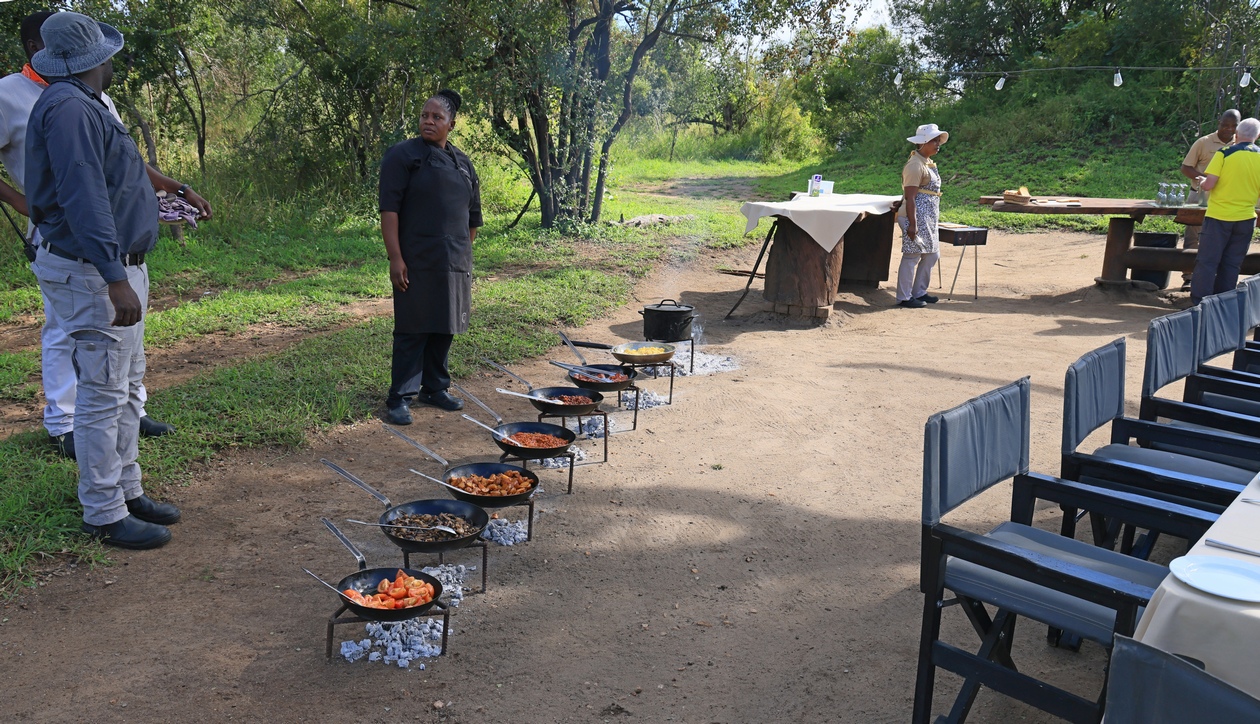
Breakfast in the woods
After breakfast, we took a somewhat round-about route to the lodges and did encounter a large elephant on the way. Like most of the animals we encountered, he just watched us pass by then continued eating the grass.

Elephant feeding alongside the road
We got back to the Tintswalo lodge, but were not done with the animal viewing yet. Remember that I said the animals could come up right into the lodge grounds? Well, here is a good example: this small group of Kudu Antelope were taking advantage of the juicy grass in the compound.
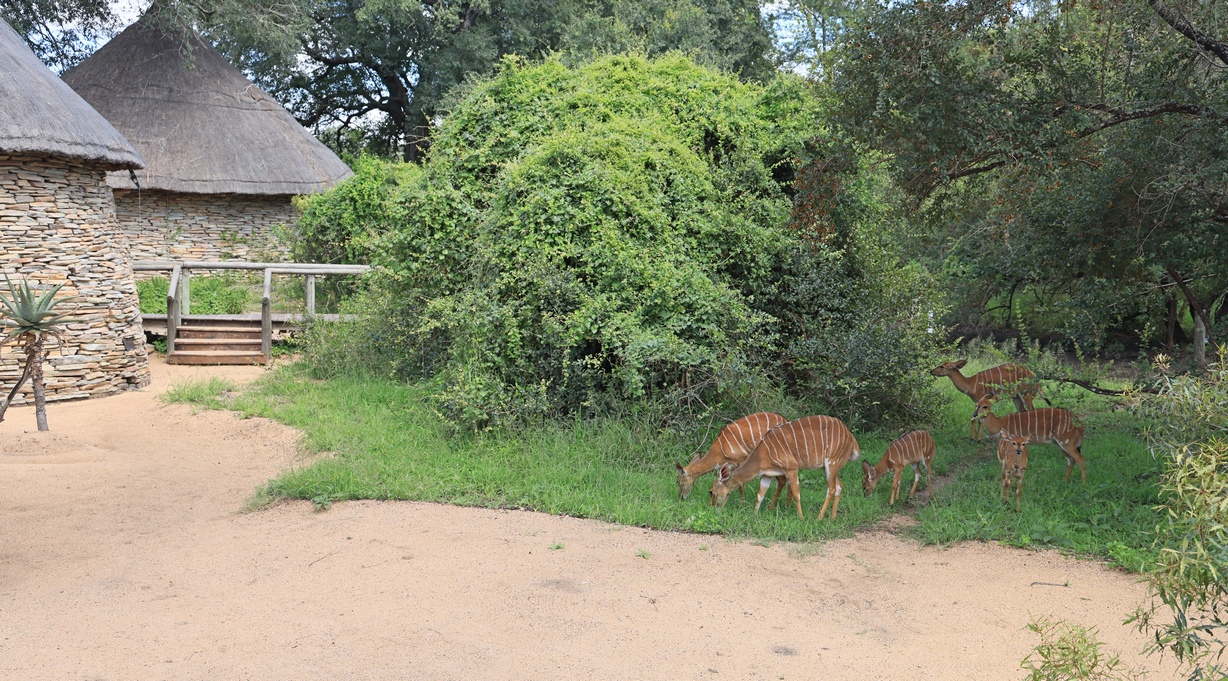
Attention: Kudu on the grounds!!
We relaxed around the lodges, had lunch and then enjoyed Tea before heading out on another animal drive about 4:00. Our main encounter this afternoon was with a small herd of elephants, probably a family. There were several small elephants, or perhaps I should say, young elephants. I’m not sure any elephant could be called “small”.
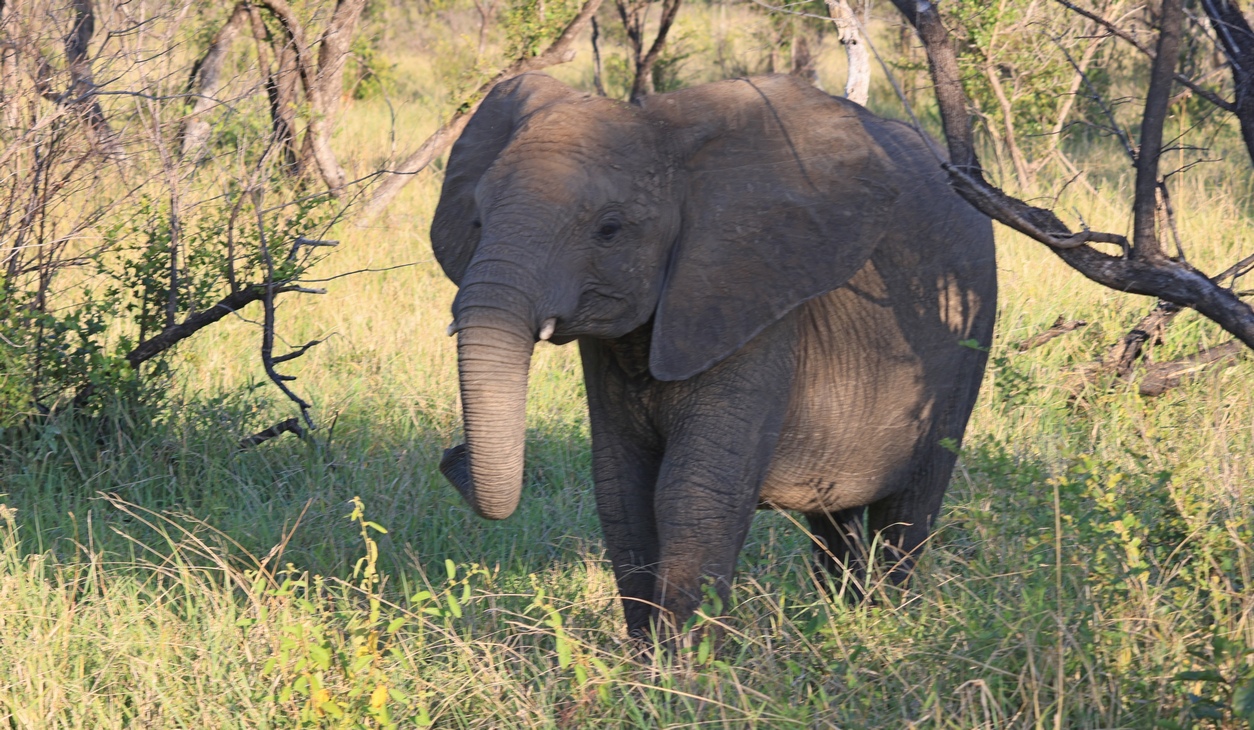
One of the young, not necessarily small, elephants
More elephants came along and crossed the road, then recrossed it the other way. One youngster seemed to be a little excited. You can get a better idea of all the activity in this video of the elephant family.
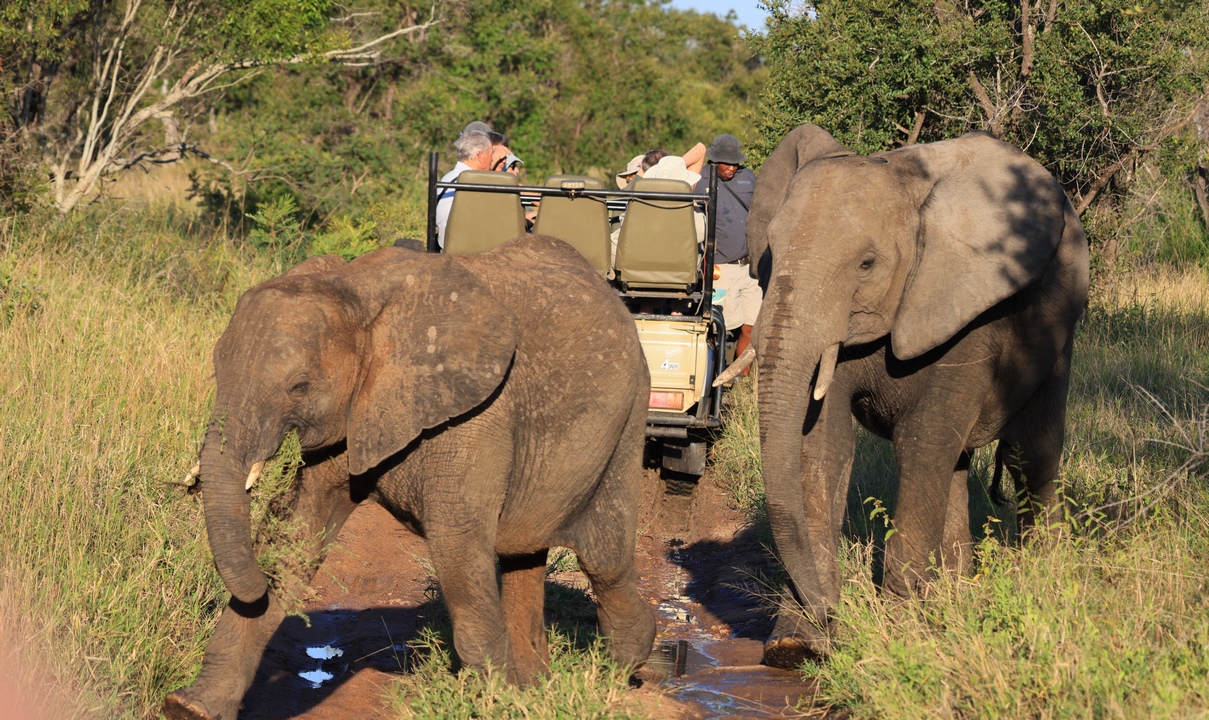
Elephants crossing the “road”
Shortly after leaving the elephants, we came across a couple of hyaenas mostly hidden in the brush. These were the first and only hyaenas we encountered on our visit and they were trying to stay well hidden so I could not get a decent photo of them. Ray, our guide/driver, said that they probably had a den with young ones nearby and that is why they were hiding.
I thought I’d throw in a photo of the other 4x4 the other six people in our group were riding. Our vehicle and that one were very similar, but a little different. Ray said that ours was lighter and less likely to get stuck in the mud and, sure enough, we ended up having to tow the other vehicle out of some mud twice.

What the 4x4s looked like
A little later, we came across the injured lion again. (I was never sure if many of our encounters were “accidental” or if Ray was getting a lot of guidance over the radio.) This was probably about a quarter mile from where we had seen him yesterday and he did not look any better: probably worse. This was the last time we saw this lion, but he was spotted the next day in yet another location, so he was still moving.

We felt sorry for this guy, but nothing we could do
Today we stopped for a somewhat lighter “snack” next to a lake. Drinks were available and cookies passed around, but someone said that we might want to leave room for dinner back at the lodge tonight.
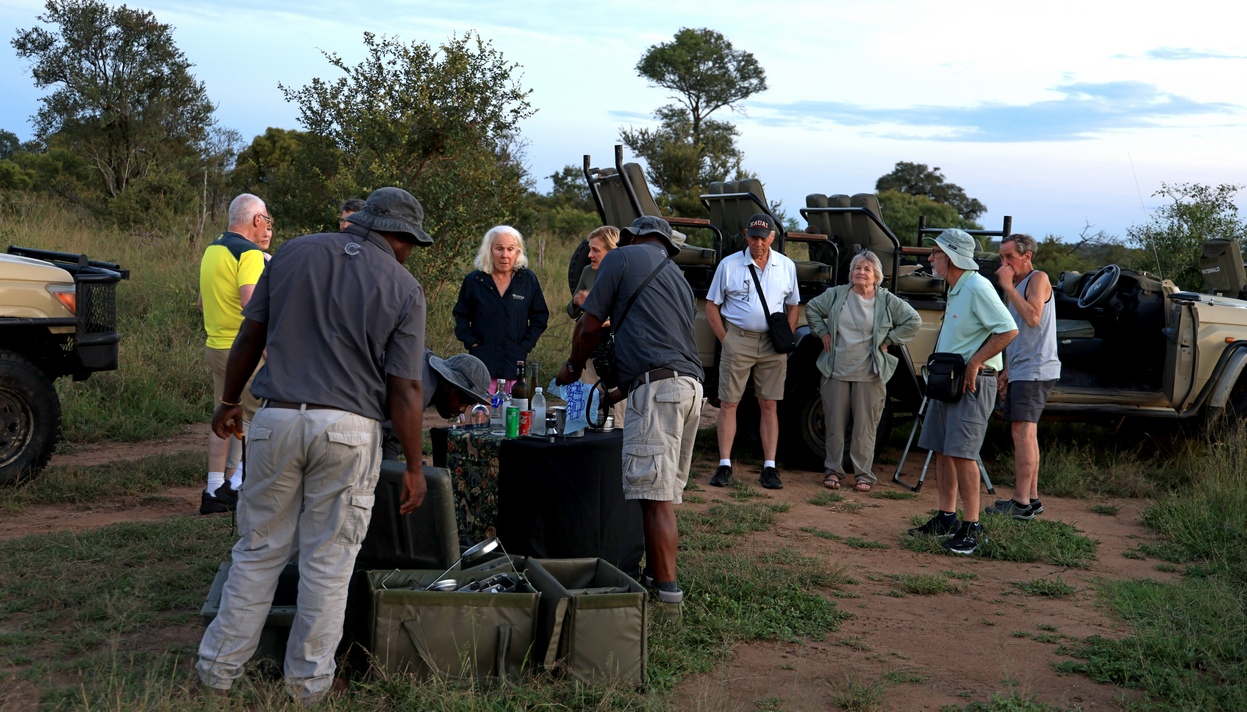
Just a light snack today
The sun was setting as we finished our snack and headed back to the lodge. Besides being pretty, the photo below has another interesting point. Whenever we were riding after dark, the tracker on the front bumper seat had a strong spot-light and he flashed it mainly up into the trees alongside the road as we went by. I inquired as to why, and as I expected, he was looking for the reflections from the eyes of a leopard. Leopards frequently spend the night in trees and, if there, they would be watching our vehicles pass. Cat’s eyes reflect most of the light that hits them and are very obvious if you are looking for them. Unfortunately, we did not see any.

Sunset (and no leopard in that tree)
Back at the lodge, everyone cleaned up quickly and came back to the main building for dinner. It was a multi-course dinner with full table service and was very tasty, but with the limited staff on duty, it stretched out over a very long time. By the time dessert was over, we were all very ready to get to bed so we could get up at 5:00 in the morning.
Thursday, March 19: Tintswalo Safari Lodge, day 3
We had another early morning today, heading out on a drive by 5:30 AM. That photo below is not another sunset photo like the one above, but this one is a sunrise photo. This morning would offer some interesting events.

Sunrise in South Africa
It was relatively quiet this morning, so I took the opportunity to get some “mood photos”, like the four (I think) hippos in the lake just below.

Hippos in a lake
It seemed that we had always seen zebras together in a herd, not one out by themselves. This one looked a little lonely.

Solitary zebra in the morning light
Then I saw a peaceful duck on the shore of the lake, with a croc gliding by just offshore. Good thing the duck was not closer to the water.

Do not go in the water, Mr. Duck!
We saw birds like the ones in the photo below, African Olive Pigeons, frequently along the roads we traveled. They were usually in the tire track part of the roads and they insisted on trying to out-run the vehicles. They could have avoided any trouble by simply dodging about two feet to the side of the road, but no, they insisted on running away from us, staying in the road where we had to go. They would run several hundred feet like this until perhaps the road turned and they kept going straight. Although they are reasonable flyers, I don’t remember ever seeing one of them flying to escape us. I don’t think we ever actually hit one, but there were some close calls.

African Olive Pigeon: not a very smart bird
We were able to add one more animal species to our list when we came up on a Jackal in the road ahead of us. He may have had his eyes on some prey (they like rodents and such) and largely ignored us, other than getting off the road. Unfortunately, he never turned to face us so I could get a good photo.
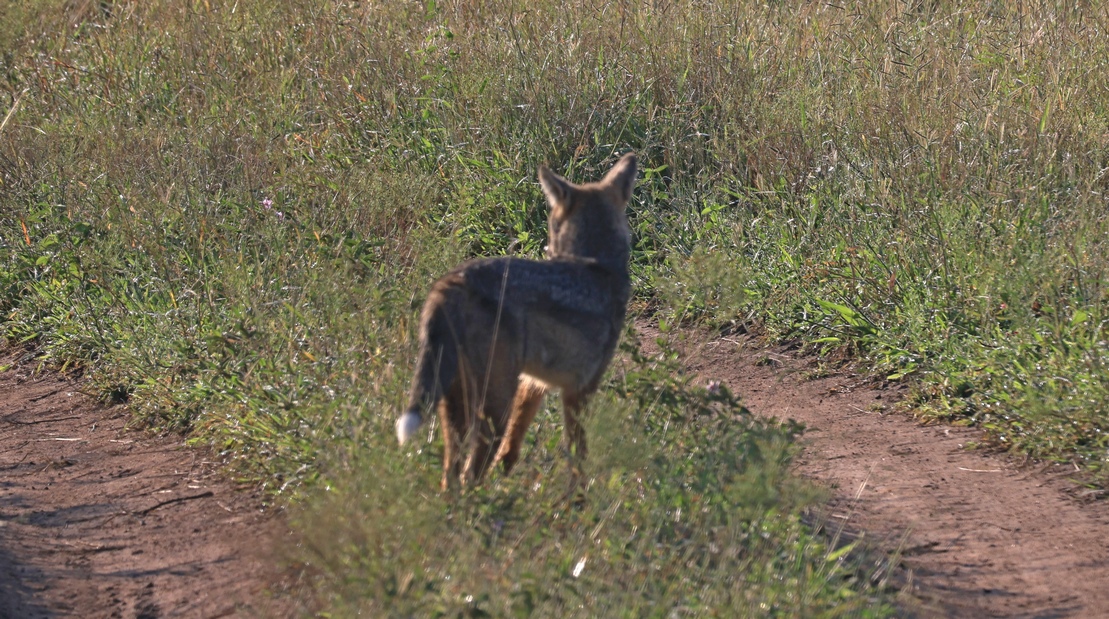
A Jackal in the road!
We came up on a large adult female elephant just off the road and took a moment to spot the youngster that was lying down just beyond her. I guess the commotion of our vehicle disturbed the young one and he slowly got up, appearing to still be somewhat tired or sleepy. The mother did not seem upset or disturbed, but she did seem to make it a point to stay between us and the youngster.

Mother and child
Our next encounter was a bit smaller than the elephants: an African Hare. African people tend to call then Hares rather than Rabbits, but it is really the same animal.
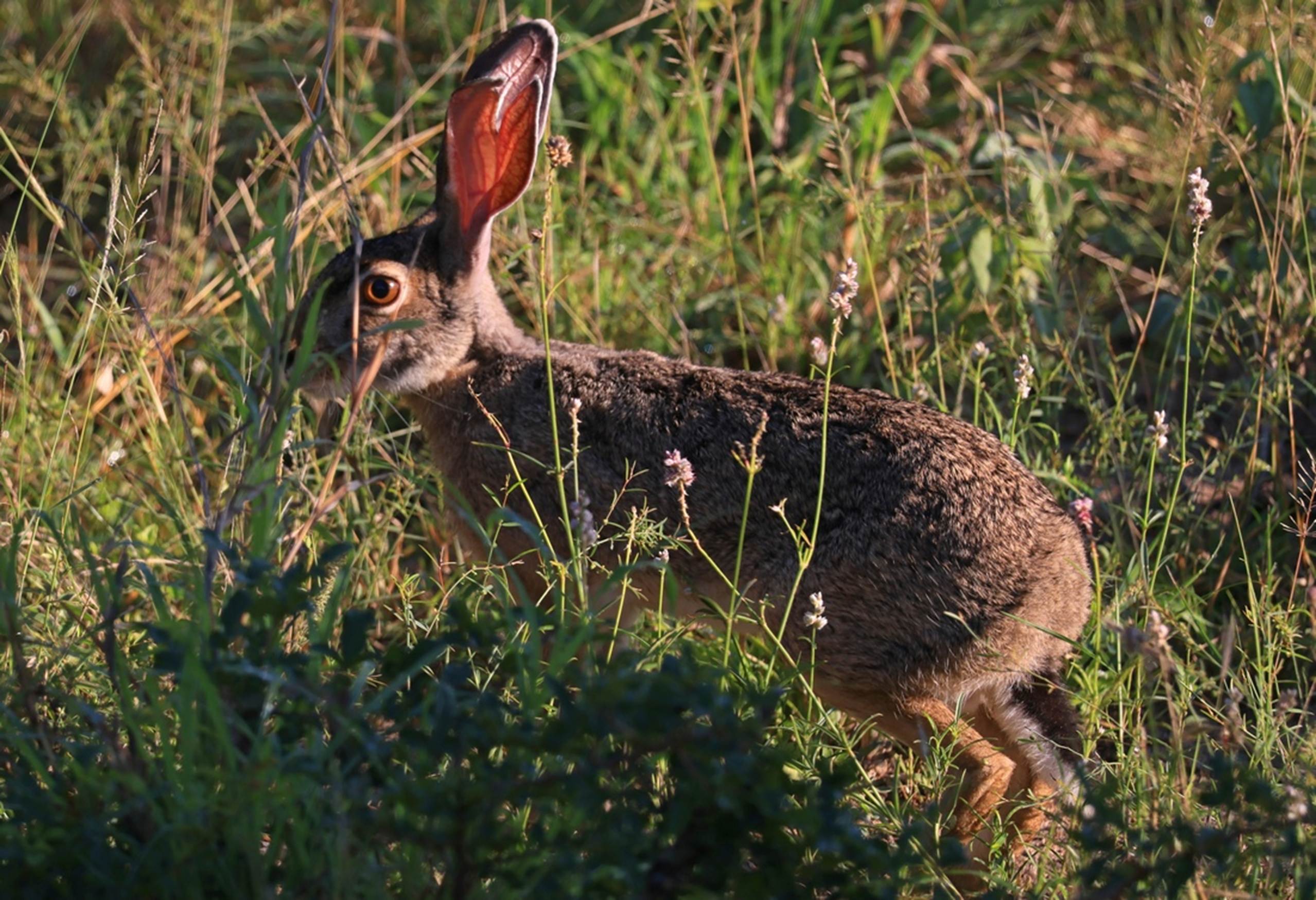
African Hare: no “cotton-tail” on this one
Time for a coffee break: we pulled up to the lake where we had a late afternoon snack yesterday. There was tea and coffee (with or without some Irish Cream) and some cookies and biscuits to dunk. The guides did ask us to not get too close to the lake today.

Coffee break time
I looked out into the lake and quickly discovered the reason we should not approach it. We didn’t know if the hippo out in the lake considered the beach in front of us to be his “territory” or not, but we did not want to find out.

I think the Hippo and I were watching each other.
Shortly after leaving the coffee break (and the hippo in the lake), we had an interesting lion encounter. I want to emphasize that, during the interaction that followed, the lions completely ignored us. Several times they walked right alongside the vehicles, completely ignoring the people, and really treating the 4x4s as just another obstacle, like a tree.
The first lion we spotted was a female walking across a field of tall grass. Ray (our guide) said that the curved tail can mean she is looking for a “romantic opportunity”. Google says that a curved tail is a “follow me” signal for other lions. In either case, it seemed to be working.
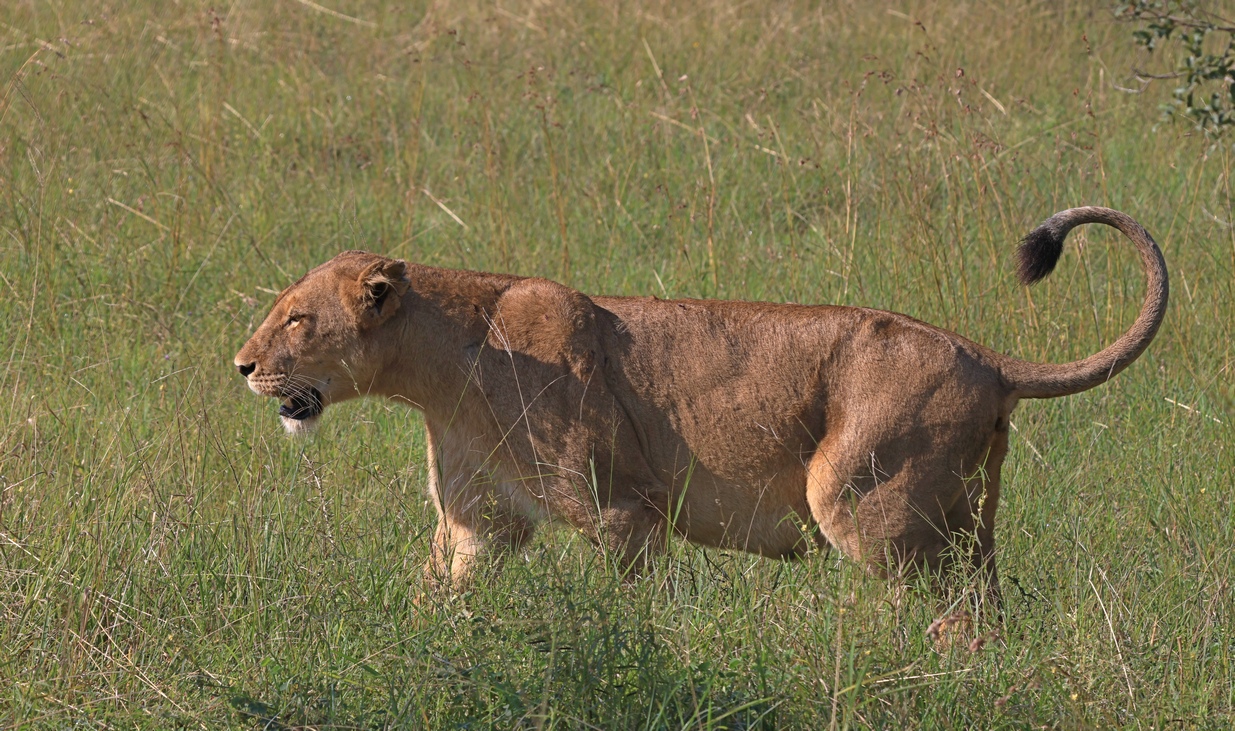
The female lion in the lead
A short distance (initially about 50 yards) away, a male lion appeared to be following the female, keeping some distance, but definitely not letting her out of his sight.
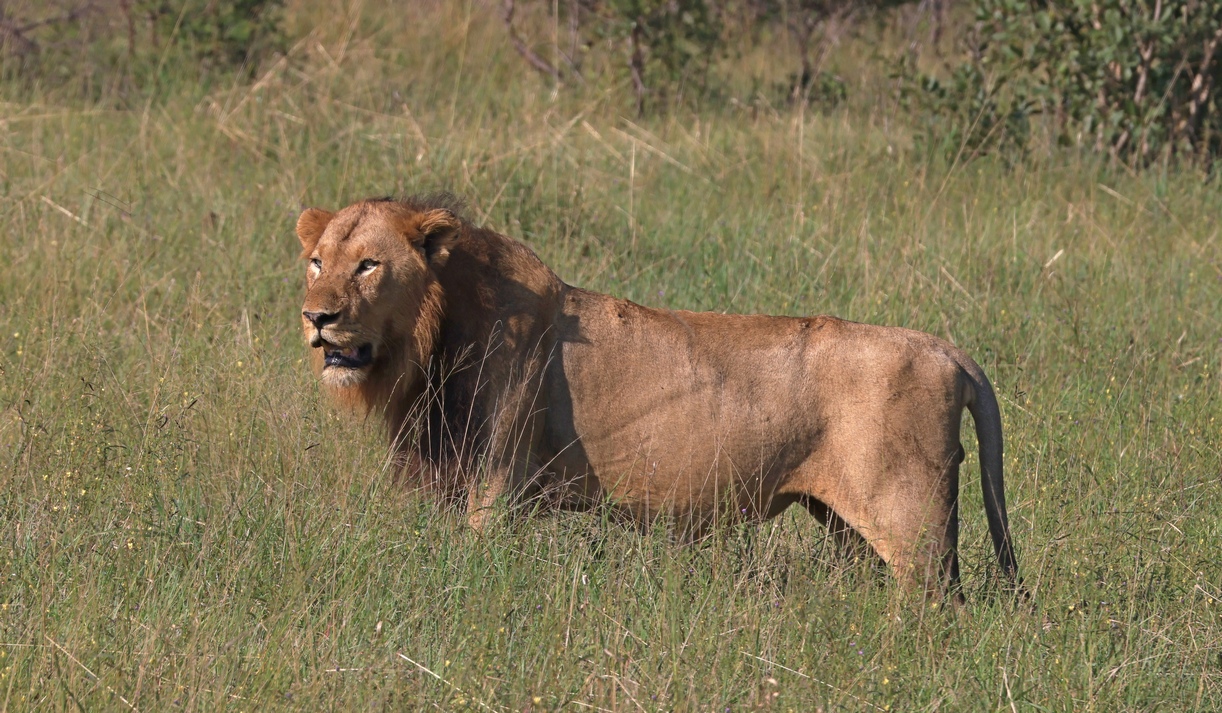
A male lion following the female
It occurred to us that this male might not be following that female if the injured alpha lion was not badly injured. We may be seeing a new alpha male being crowned. The female walked along the road, alongside the other vehicle, and across just in front of it.
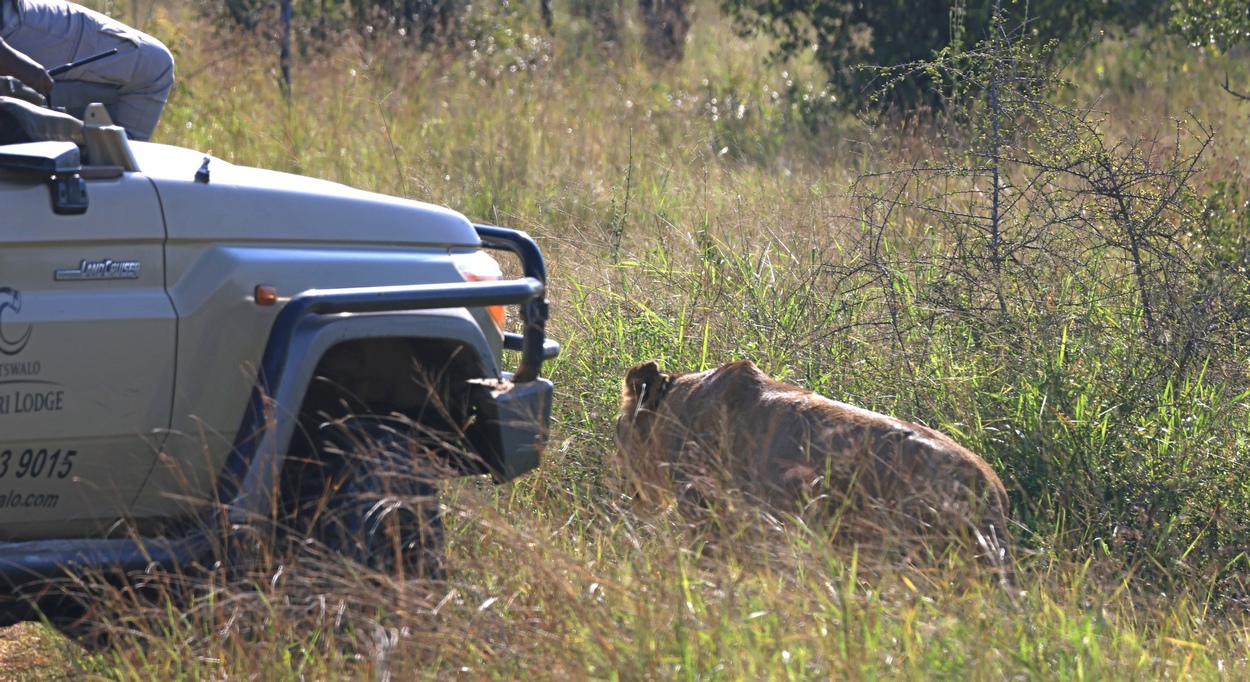
The female crossed right in front of the 4x4.
And the male lion followed in her foot steps. You can see the leg of a tracker sitting in his very exposed seat of the vehicle. The lions showed absolutely no interest in us, but I think I would still have been nervous.
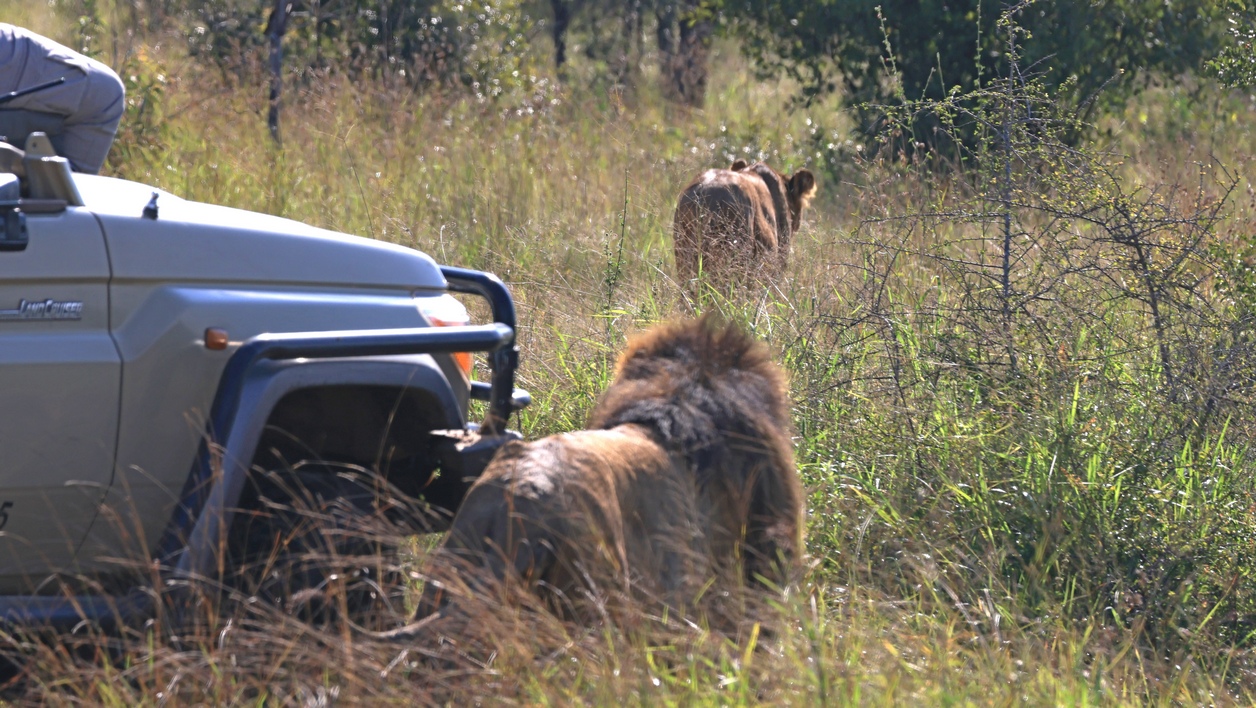
Male follows the female
When we looked back where these lions had come from, there was another male lion making his way along the same path. Now there were two males following the female.

Male lion number two
And, in the distance, here comes another male lion, across the field and headed along the same path as the others. Now there were three males pursuing the one female.

Male Lion number three
The female lion stopped in the shade of a tree for a moment, but then continued off through the brush and high grass with the others following, so we did not attempt to follow them. If you want to watch a slightly condensed version of this encounter, check this video of the four lions.
One more interesting sighting before the end of the drive, a small group of Southern Ground Hornbill with their gaudy red color.
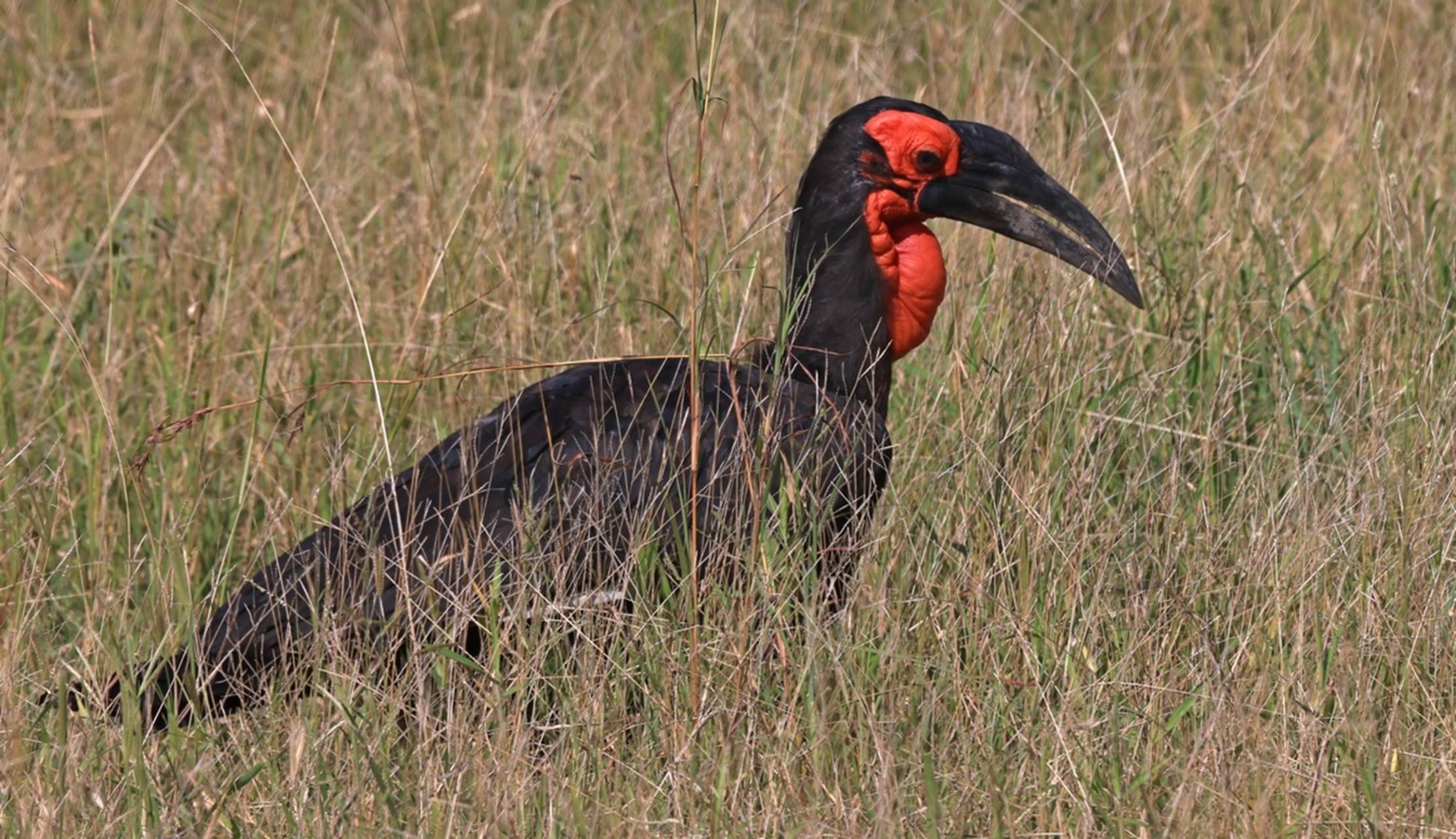
Southern Ground Hornbill
We headed back to the lodge area and, when we got there, Ray said he wanted to go out on another short drive in a different area we had not been to. He had a name for this kind of drive, which I cannot remember, but a couple of us said we’d be glad to accompany him. His objective turned out to be a lake we had not visited yet, but we did spot a few animals on the way there, such as a Waterbuck showing off the “target ring” on their rump.
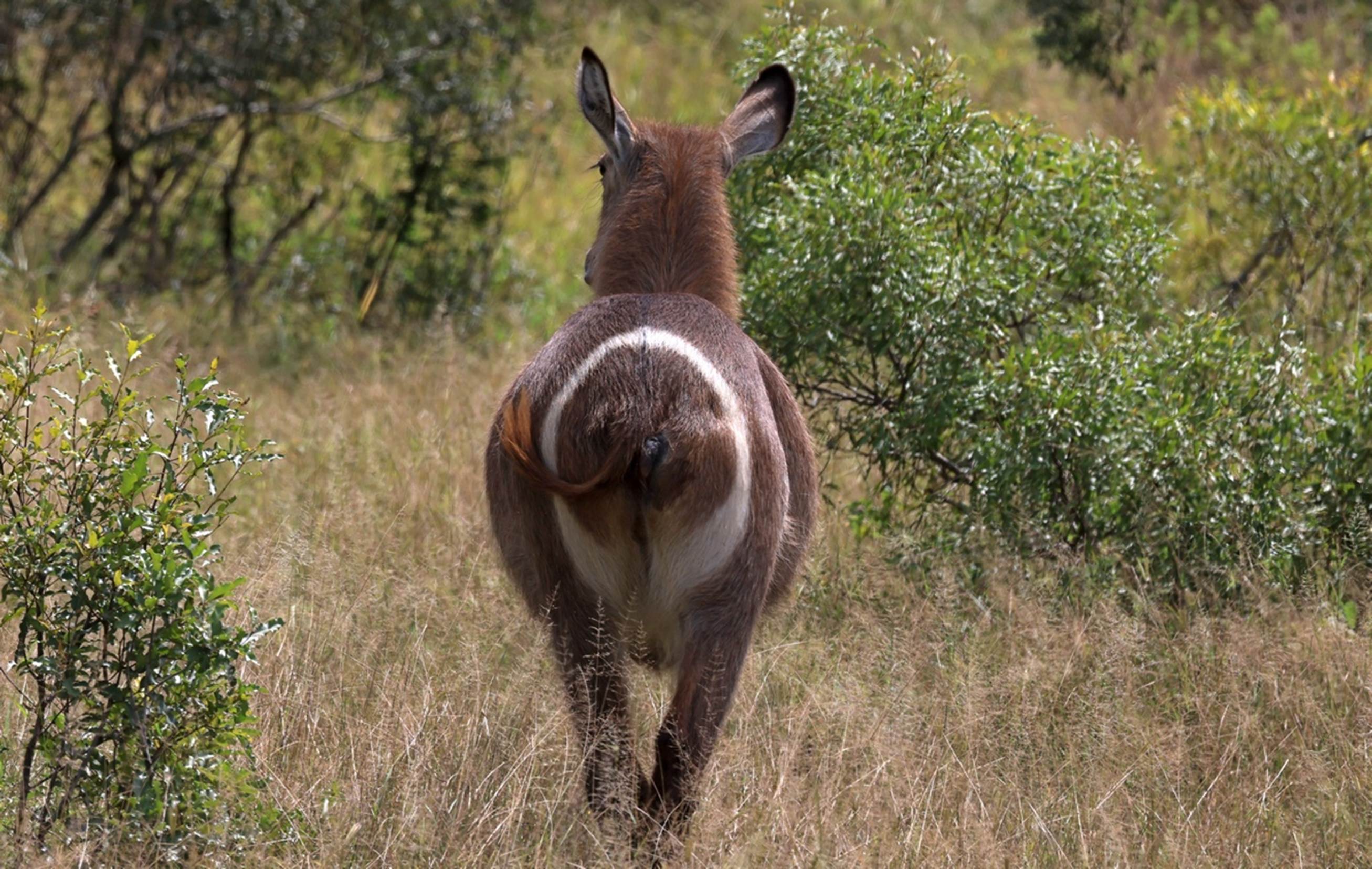
How would you like to have a target on your butt?
A little further along were some wildebeest hanging around and feeding on the plentiful grass.
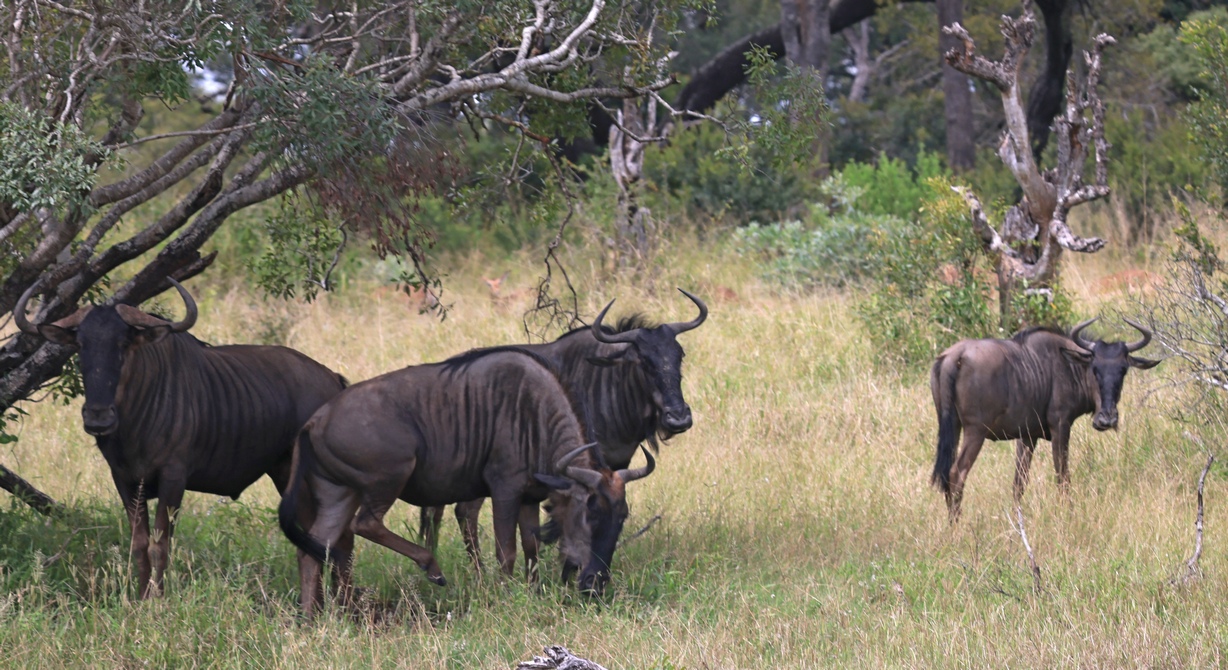
Just a few Wildebeest
In the lake there were several water birds and at least one hippo out in the middle of the lake. In the shallow area there were some ducks and the Black-headed Heron in the photo below.

The heron was wading in the shallow water
Something disturbed the heron and he decided to go elsewhere, giving me the opportunity for a “keeper” photo.

A Heron in flight
Impala antelope tend to hang out around water, and we saw a small group which were doing just that.
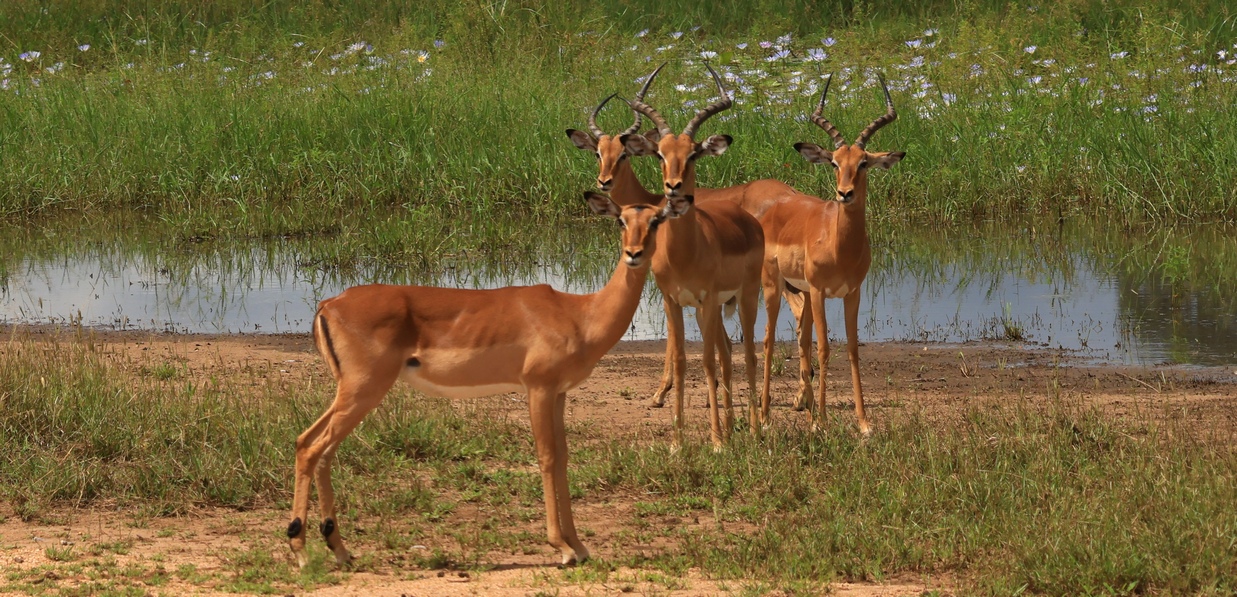
Impala hanging out around the lake
We had been watching some storm clouds for some time and they were rapidly approaching so we headed back to the lodge, getting there very shortly before the rain hit. We had a pretty good rain that lasted for several hours. Just what we needed: more water in the roads. There was serious consideration of canceling the afternoon drive because of the muddy roads and chance of more rain, but the weather cleared enough that the guides decided we could go after all.
Despite the fact that we almost cancelled the evening drive because of even wetter roads, Ray decided to check out some roads that we had not been using because they tend to flood more than the others. Let’s see… roads that were already too wet, plus additional afternoon rain, and we’re going to give them a try. I think it is safe to say that the driving conditions provided most of the excitement this evening, rather than the animals. On some of the road sections I definitely did not expect that we would be able to get through the mud and water. There were other sections where the ruts were so uneven that it seemed we were in significant danger or tipping over. Before going over one flooded stream, Ray gave us the (unneeded) instructions: “If we start to tip over, JUMP!”.
Going alone one waterlogged section of road, we came to a large elephant using the road to go the opposite direction. We, of course, pulled off the road as much as we could and allowed the elephant to pass, using the road. You can see one of the drier parts of the road just behind the elephant in the photo below.
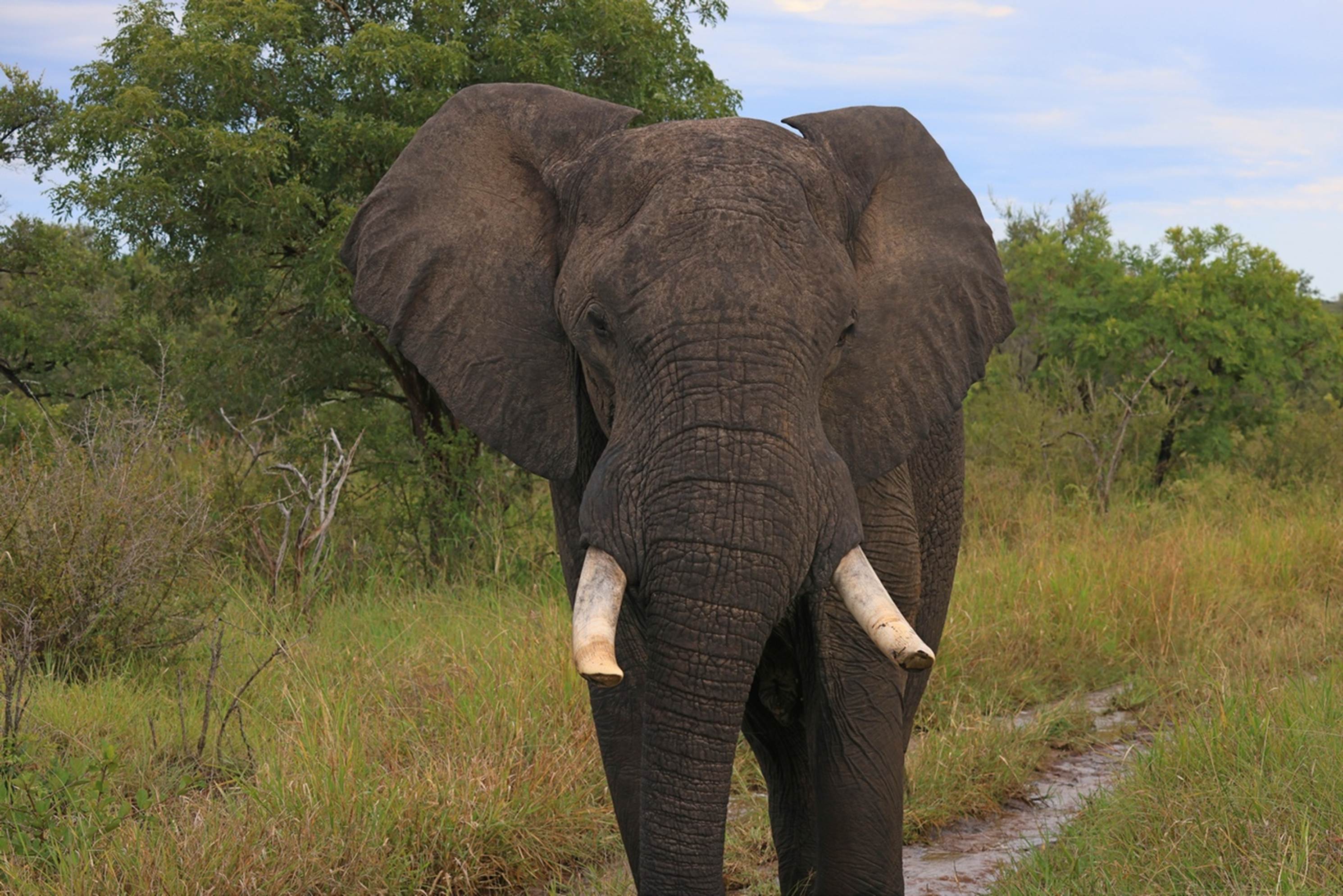
The elephant always has the right-of-way.
In the photo below, you can see that there is a lot of water in the two tire tracks/ruts. What you cannot see, and neither could Ray, is whether the two ruts are at the same level. In the case below, I believe the rut on the left was almost a foot deeper than the one on the right, pitching our vehicle precariously to the left. This was a very common occurrence on the drive.
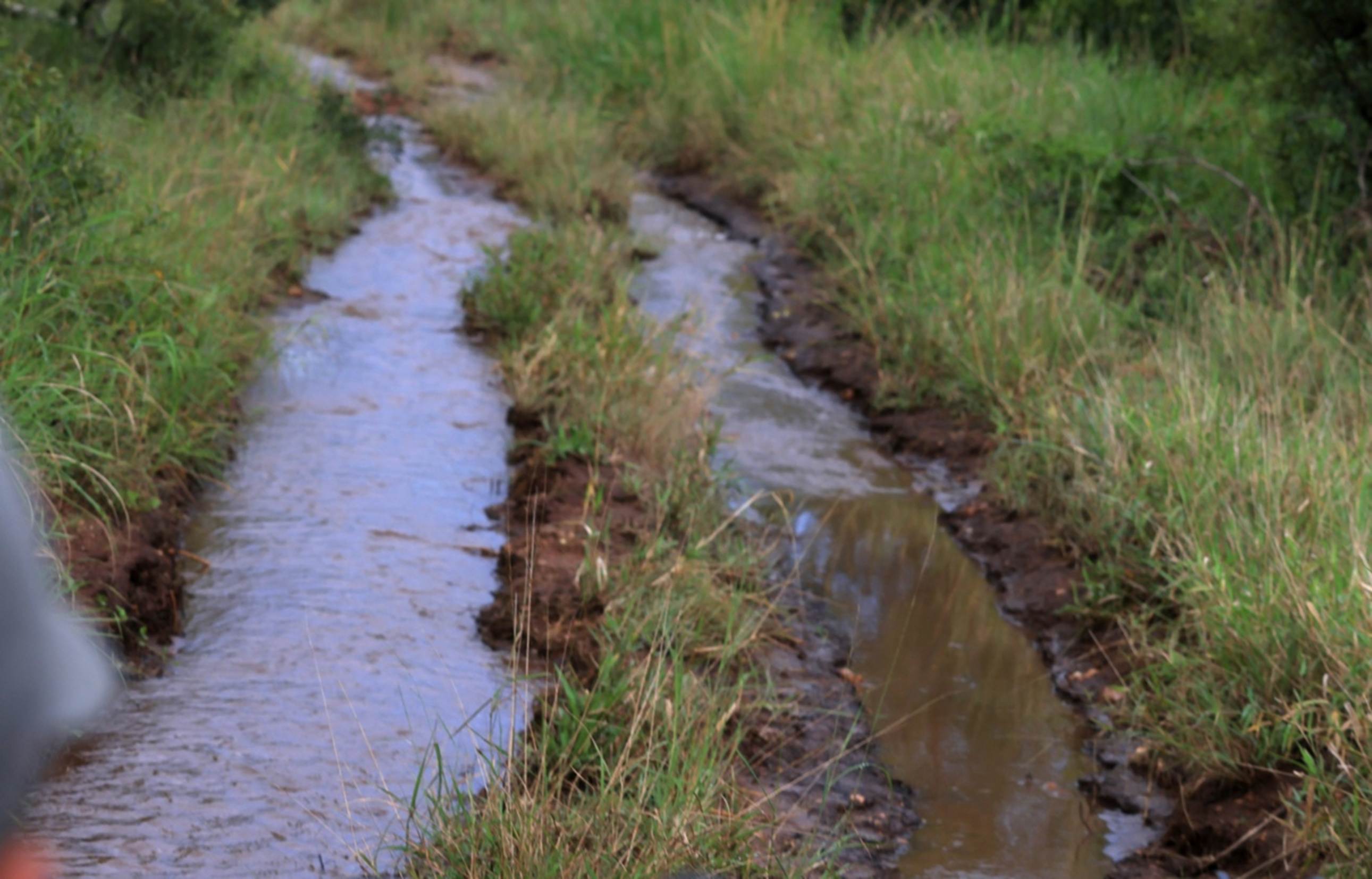
Just how different are the ruts?
There were several “bridges” to cross along the way. Most of them actually had a concrete slab that was under the water, but it was impossible to see just where the slab was and whether the water flow might have shifted it to one side. The photo just below is of one of these “bridges”, hopefully with a concrete slab still in place under the water. It took two attempts to get up the very slippery slope on the other side, but we made it with no major damage. (Just some splatters of mud on me, up on my rather elevated seat.)

There is a “bridge” there somewhere.
We continued, even as the day turned into night. At one “bridge” crossing, someone had asked Ray to get a video of the other 4x4 from our lodge crossing the stream, so we stopped while the other vehicle crossed and we took videos. Ray took his video, but I think my video of the crossing was even more interesting. This crossing was actually relatively easy, compared to some others.
On the way back to the lodge, the tracker was flashing his light through the trees looking for that leopard as usual. He did not find a leopard, but he did spot an owl up in a tree, so we had to get photos of it. The owl actually looks somewhat “spooky” sitting up in that tree at night.

A rather “spooky” Owl
With all the rain and poor roads, there was no “cocktail hour” or appetizers on the drive today. We got back to the lodge and enjoyed a clean and dry dinner on the deck.
Friday, March 20: Tintswalo to Johannesburg and Home
There was another early morning animal drive scheduled this morning, but Susan and I decided that, since we were going to have a long day, followed by a long flight, it would be better to get a good night’s sleep and relax while packing in the morning. Several others in our group did the same thing. We slept in a little while, then did some relaxed packing while the others were out wandering the wet roads. When they got back, we all had a good breakfast and watched some Kudu grazing very close to the deck. A couple of young Kudus came up very close, probably less than 10 feet from the deck while we watched and were very quiet.

The young ones came up much closer than this.
We said good-by to the Tintswalo staff and, about 10:00, we loaded up the luggage trailer and passenger van and headed to the airport. Hoedspruit is a very small airport, with a very small check-in area. Somehow, I ended up at the head of the line, explaining to the counter person what we were doing for all of our group. He had just gotten the idea when the power went out. They tried to do some of the check-in manually but then the power returned and we had to wait until all the computers were restarted. They had collected passports in order to do the check-in so when that part was complete, I had to (re)distribute the passports. Then when the boarding passes were finally done, I got to distribute those also. All our bags were checked in and were somehow checked under only one person’s ticket: guess who that person was. That made a few people nervous. We finally made it through the security check and into the waiting area where there was some additional confusion since there was no flight number, boarding time, or gate number information and there were several planes on the tarmac. Our plane finally pulled up and we could get on and I watched to make sure at least some of our baggage was loaded. The flight to Johannesburg was short and comfortable on a very nice day.
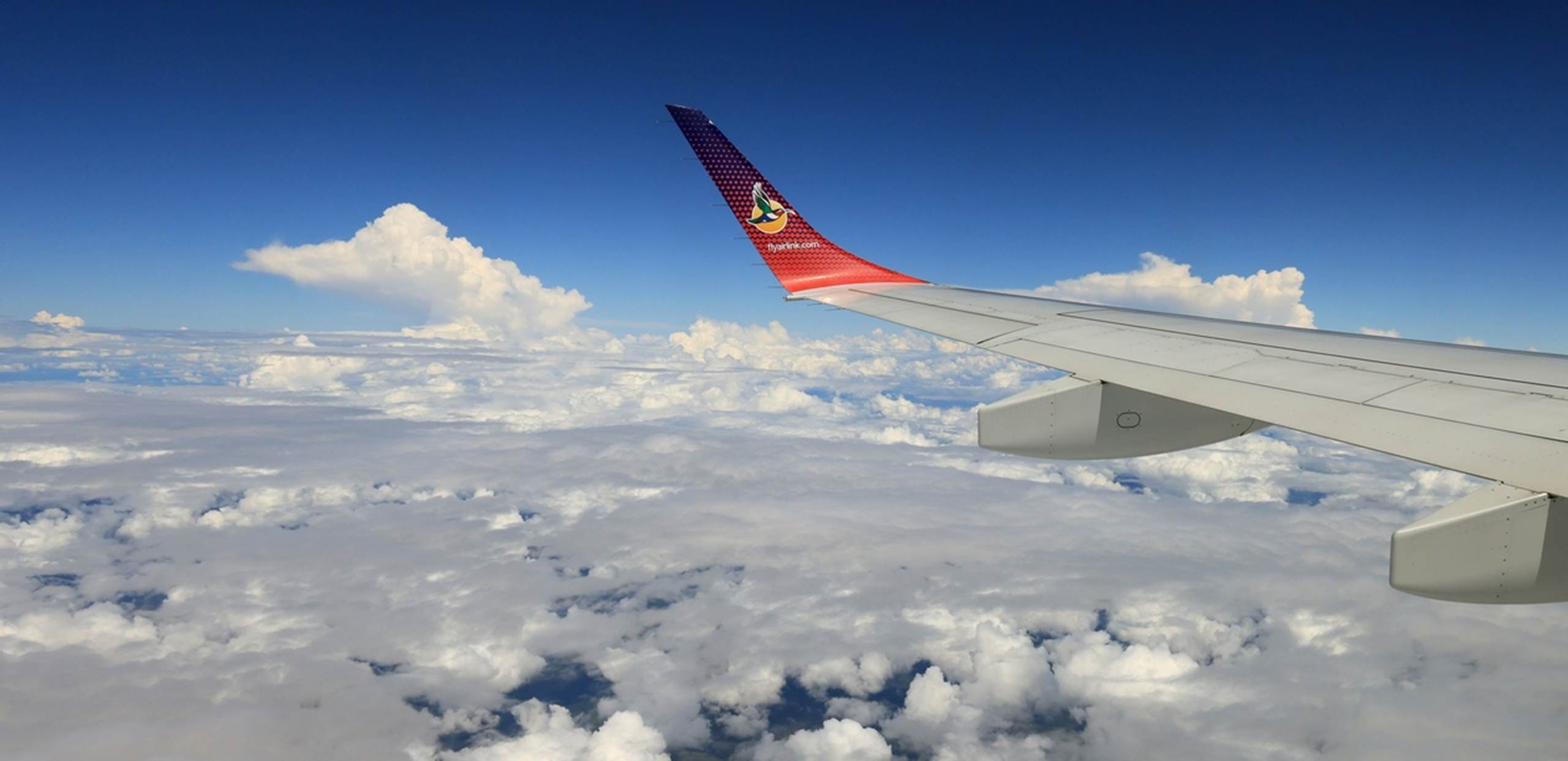
Another nice AirLink flight
We arrived in Johannesburg and found our luggage: thankfully, it was all there and accounted for. An AMA Waterways representative met us and directed us toward our respective gates or, in some cases, to their local hotel. By now it was about 2:00PM but we found out that the Delta ticket counter would not open until about 5:00 (our flight departure time was 9:55PM) so we decided to get some lunch at an in-airport pizza place and then we found some comfortable chairs to read and wait until 5:00. When the Delta counter appeared to open, we (and 4 others of our group on this flight) checked in. The lady at the ticket counter said that we could make use of the SLOW Lounge and gave us (approximate) directions to it. We got through security check and immigration (another passport stamp) then had a minor adventure locating the SLOW Lounge. Once we did find it, we enjoyed their fairly extensive wine and food for several hours, until time to head to the gate for our flight. The flight departed on time and we had another meal, and more wine, on board. Between the relatively late departure, the wine, and the Delta-1 almost-lay-flat seats, I was able to get probably 4 or 5 hours of sleep, which is almost a record for me. Arrival in Atlanta was a little early and the Global Entry route through immigration was almost a joke, but it was very quick. With a good Uber on a Saturday morning, we were home in time to get in almost a full day of cleaning and organizing the house and yard after the long absence.
For a 7 minute video summary of our time at Tintswalo, check: https://www.youtube.com/watch?v=0XrnOPA6OnU
You should now click on the “Back Button” (perhaps several times) to get back to the main document.