
 Chapter 1
Cape Town
March 6, 7, & 8

Starting in Cape Town
Thursday, March 5: Cape Town, South Africa
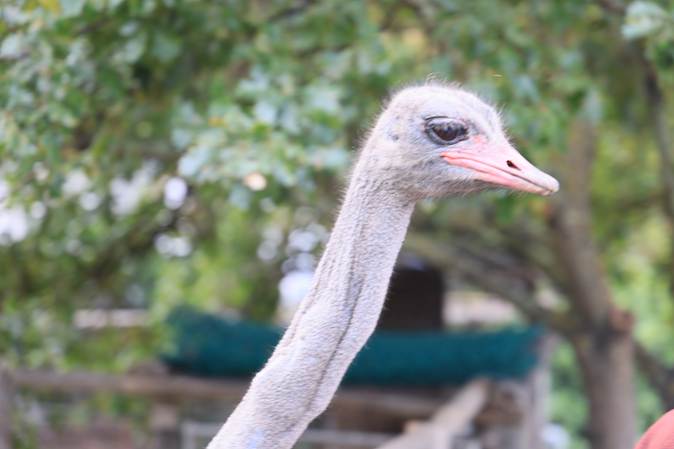
Check the small photos at the top of this page. I suspect that an Ostridge and a Penguin might not be the animals you first think of when thinking of Africa, but they were about the first “unusual” animals that we saw, so they earned a place in this report.
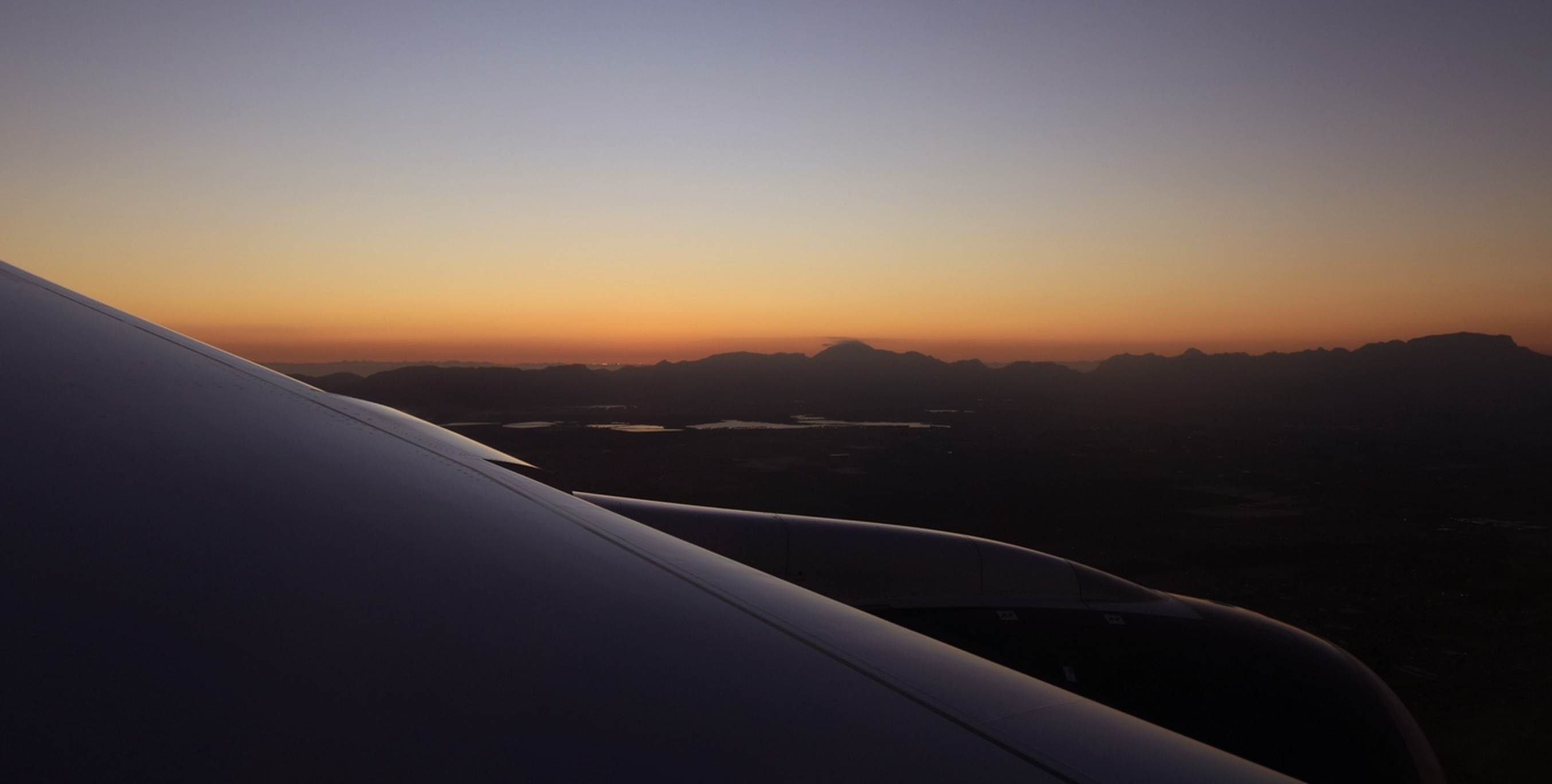
Colorful sunset as we approach the Cape Town airport
Arrival
Our arrival went about as smooth as you could ask for: considerably better than several of our other recent arrivals in a foreign country. We did have a rather long walk in the Cape Town airport from the arrival gate to the Immigration, baggage claim, and Customs processing area, but after more than 15 hours sitting in a plane, it felt rather good to take a long walk. The immigration process was very simple and we were not asked for the Health Declaration form that we had prepared. We waited about 10 minutes for our luggage to show up, grabbed it and walked through the Customs area with just a friendly “Welcome” from the customs officers. Once out in the exit hall, we quickly found the AMA Waterways representative wo guided us to a car with a driver who would take us to our hotel.
Our hotel, the “Cape Grace” (A Fairmont Managed Hotel) was literally in the middle of the marina area, about a 25 minute ride from the airport. We received a very personal and friendly welcome and were escorted to our nice room. By this time it was about 8:30 or 9:00 and dark in Cape Town. We had been served a breakfast on the flight in the morning, and a light meal a little before landing, so we were not really interested in getting anything to eat: the bed looked more inviting that any food would.

The Cape Grace Hotel in daytime
We unpacked, settled into our room and called it an early evening.
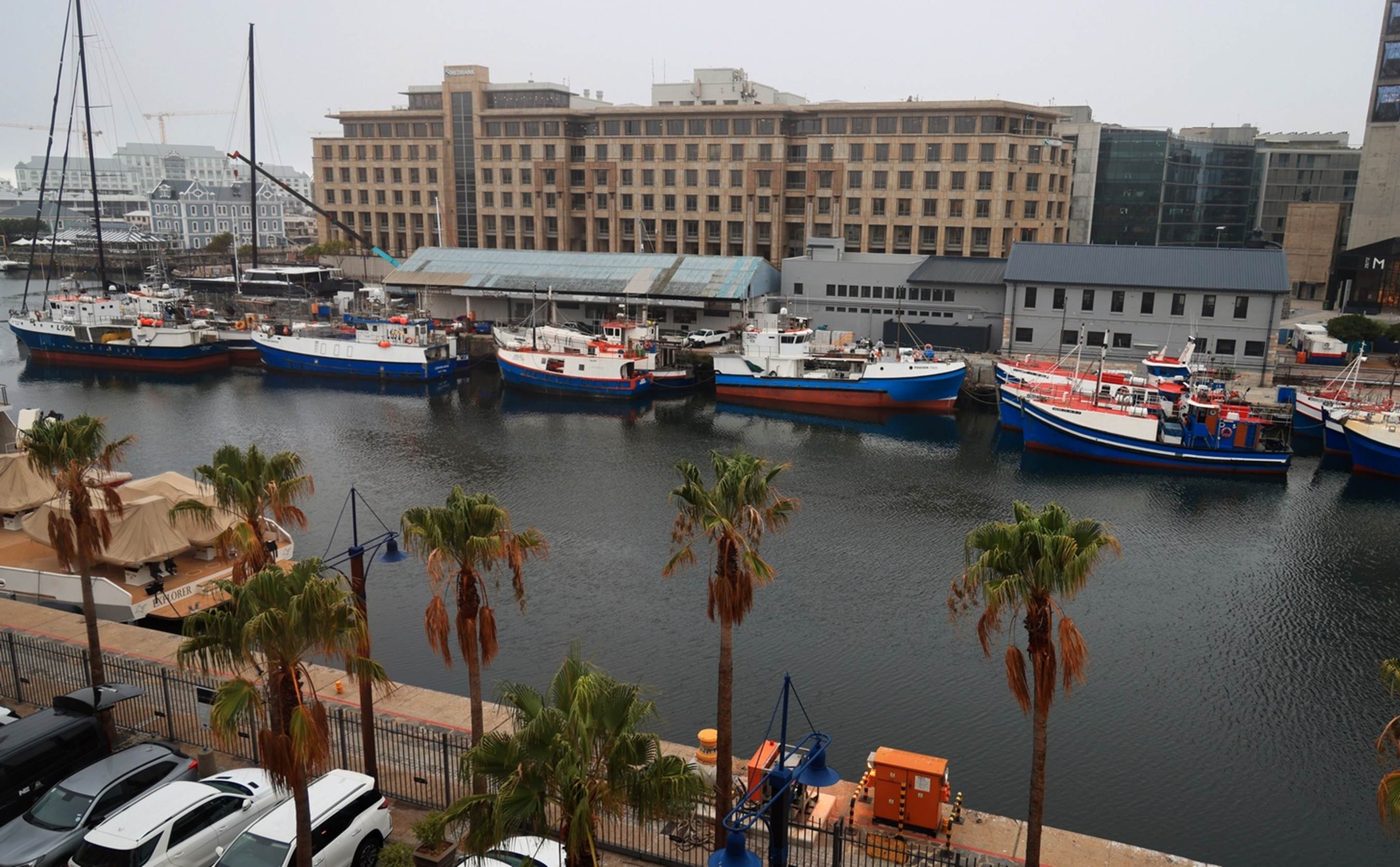
The view out our room’s window
Friday, March 6: Cape Town Wine Tour
Since we had a fully day to spend before our 6 PM reception and introduction with AMA Waterways, I had signed us up for a full day wine tour. Several friends had told us how beautiful and tasty they had found the wine region of South Africa, so I had gotten us into a small group (7 people, it turned out) tour , visiting four wineries and the town of Stellenbosch. The information about the wine tour said that it would start about 8:30 and be done by 5 or 5:30. I probably should have known better… The tour was done by/through “African Story Tours” and our host and driver was a very pleasant and knowledgeable middle aged man and I wish I could remember his name.

Our transportation for the day
We were told that our pick-up at the hotel would be between 8:30 and 9, so we ate breakfast in the hotel and got ready, getting to the lobby right at 8:30, and our host/driver was waiting for us. We picked up 5 more people at other hotels before heading to wine country.
Fairview Winery
Our first winery to visit was the Fairview Winery, with extensive grounds and multiple buildings and very nice facilities for hosting visitors. Our host seemed to know everyone at all the wineries we visited, so we didn’t bother the winery people and he tooks us on brief tours of each winery. The Frirview winery had a large fermenting room with lots of stainless steel tanks and a barellel room with plenty of oak barrels filled with wine.
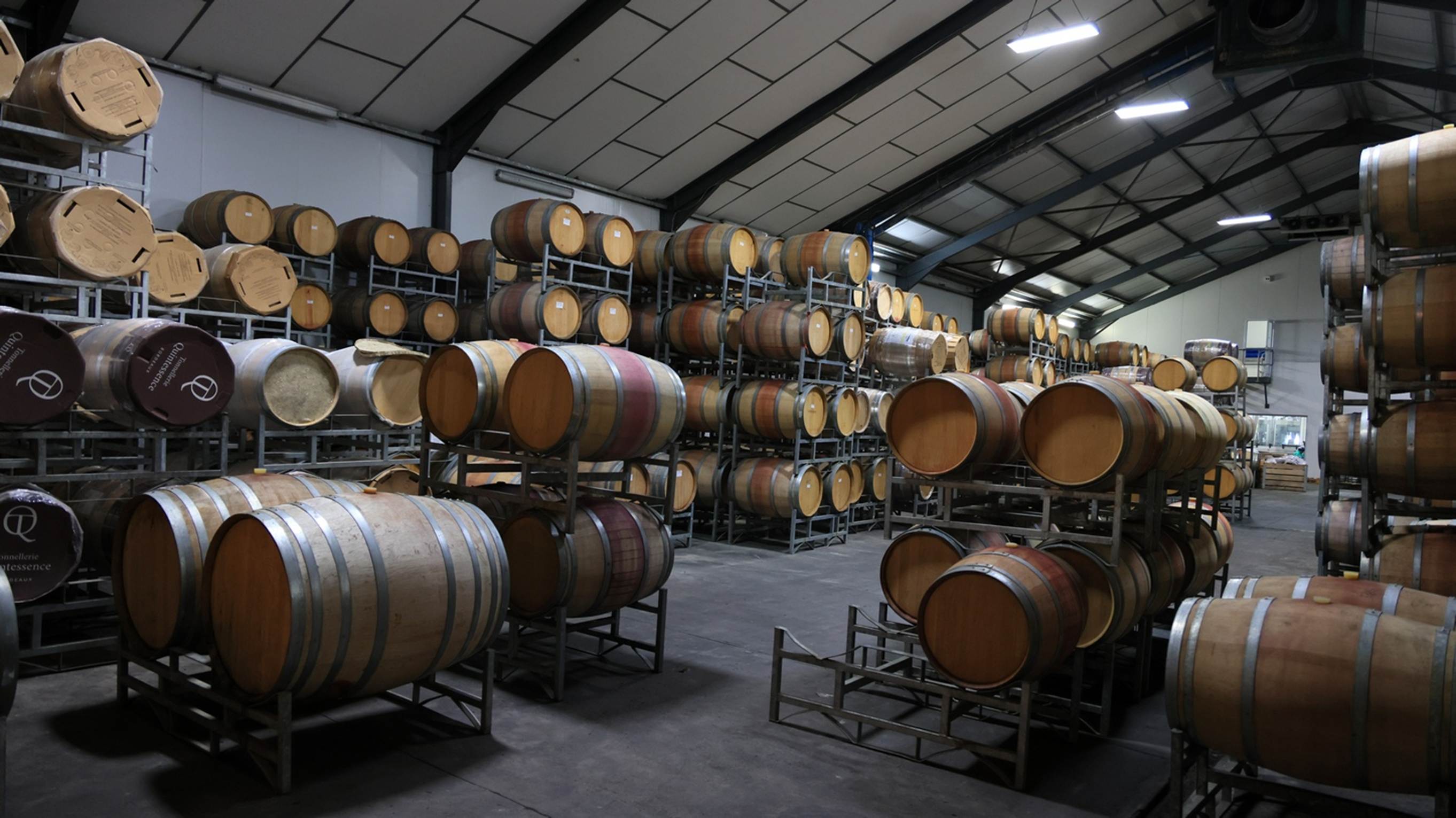
The Barrel Room at Fairview Winery
After a brief tour, we settled at a tasting table where each seat had a wine glass and a small board with a variety of cheese and sausage samples. We tasted seven different wines, from a Chenin Blanc to a robust Cabernet, each paired with a specific cheese or sausage. All the wines were good, but I don’t remember any being especially memorable, although perhaps it was still a bit early for me to be tasting wine (about 10:00 AM).

One of several tasting tables: note the boards with cheeses and sausage
After looking around their small “general store” with blocks of the cheeses and lkinks of the sausages we had tasted available for sale, we climbed back in the van andc headed to the next winery.
Eikehof Winery
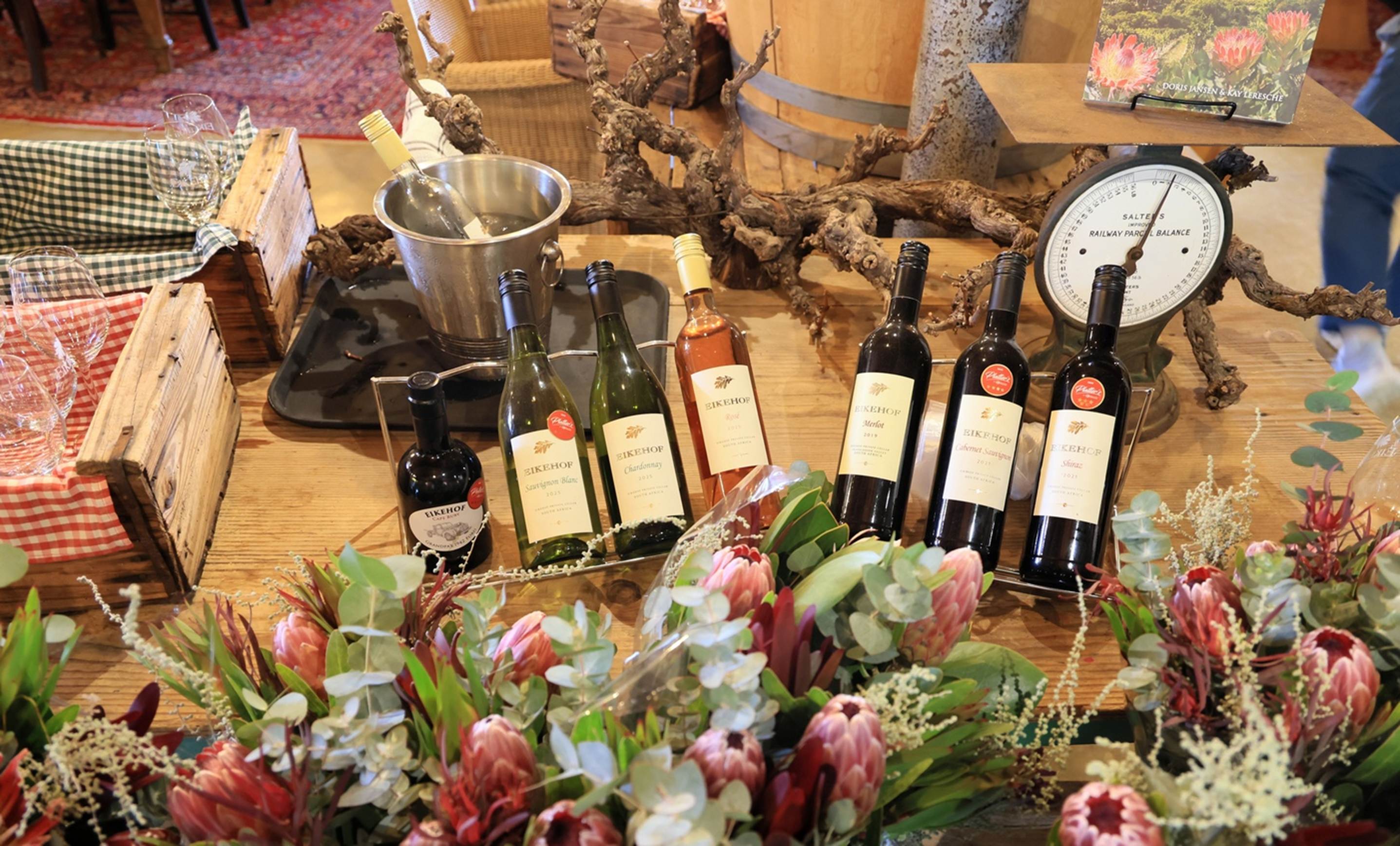
A display of some Eikehof wines
In many ways the Wikehof winery was just the opposite of the Fairview winery: it was small, very family oriented, and offered a very casual tasting arrangement: picnic tables. We sat around the table whlle ether our host or someone from the winery would pour tastes of wine and we would talk abouit each one. I think this might be where I realized that I really liked the best known of the South Africa wines, Chenin Blanc. There was the usual range of wines, ending with a Cabernet, and all were good.

A bit more relaxed tasting table
One feature of the Eikehof tasting room was the view out the sliding glass door, so after finishing the tasting we all wandered out the door and checked out their “back yard”. The plants in the field below are grape vines that, for a number, of reasons are grown as bush plants, rather than up on a trellis. Although many different wine varities are grown this way, it is probably most popular for the more native South African grapes such as Chenin Blanc and Cinsault.
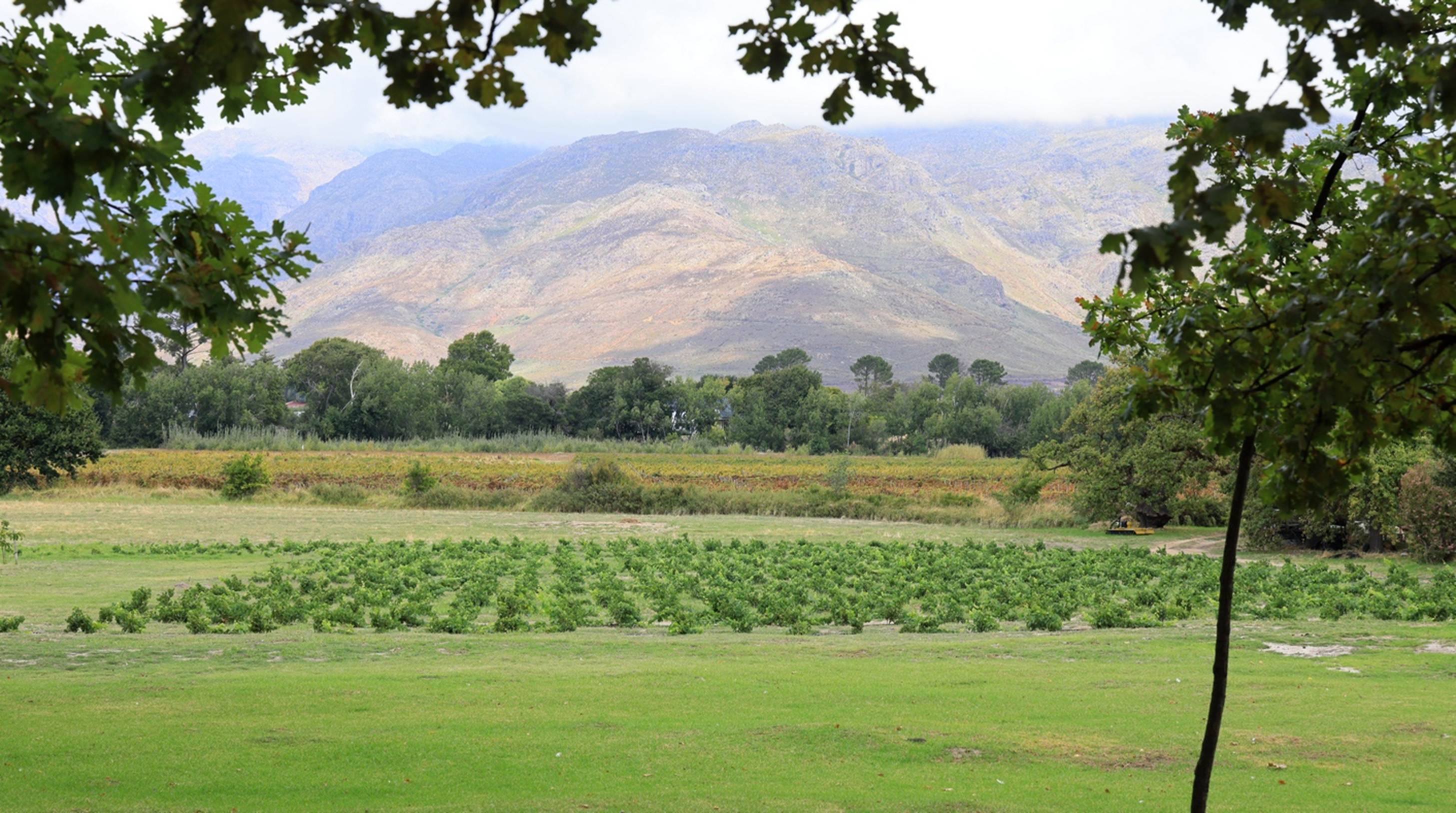
A nice view out the back yard
We wandered around in the back yard a couple of minutes until our host sayd “Come on over here and meet a friend of mine.” In the far corner of a fenced in area were a Impala Antelope and an Ostridge. Our host had some kind of food in his hand, called to the Ostridge and here is the result. In the video, it looks like the Ostridge is a little heavy-handed, but it was actually very accurate and gentle when taking food from someone’s hand: I know from personal experience.
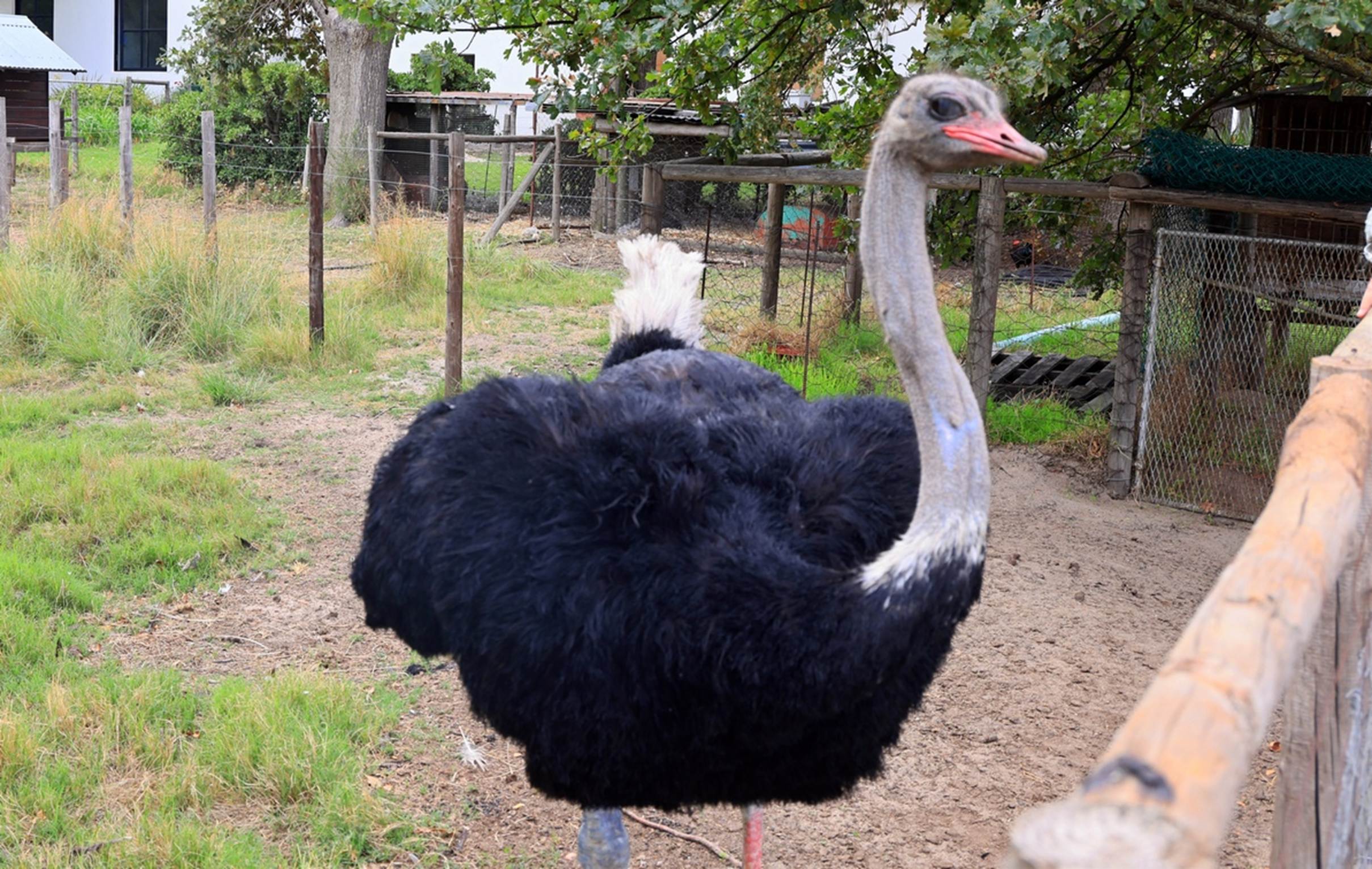
A very friendly Ostridge
The Impala was too shy to come over to us, but the Ostridge was happy to stand around and get some attention and more snacks. By now it was a little after noon so time for some lunch!
Le Pommier Winery
Another short ride brought us to the Le Pommier Winery, a more modern and larger winery than Eikehof, bit not as large as Fairview. Here we had our own little building where a table was set with wine glasses and silverware.

The main building at Le Pommier
The tasting room (photo below) was separated a bit from the main building and we did have another nice view out the back window. We sampled several wines as we enjoyed a reasonably light but tasty lunch. Toward the end of the tasting and lunch, the hostess from the winery passed out some squares of different flavors of chocolate, encased in wrappers with the “African Story Tours” name and logo. It seems our driver/host was promoting his business in several “tasteful” ways.
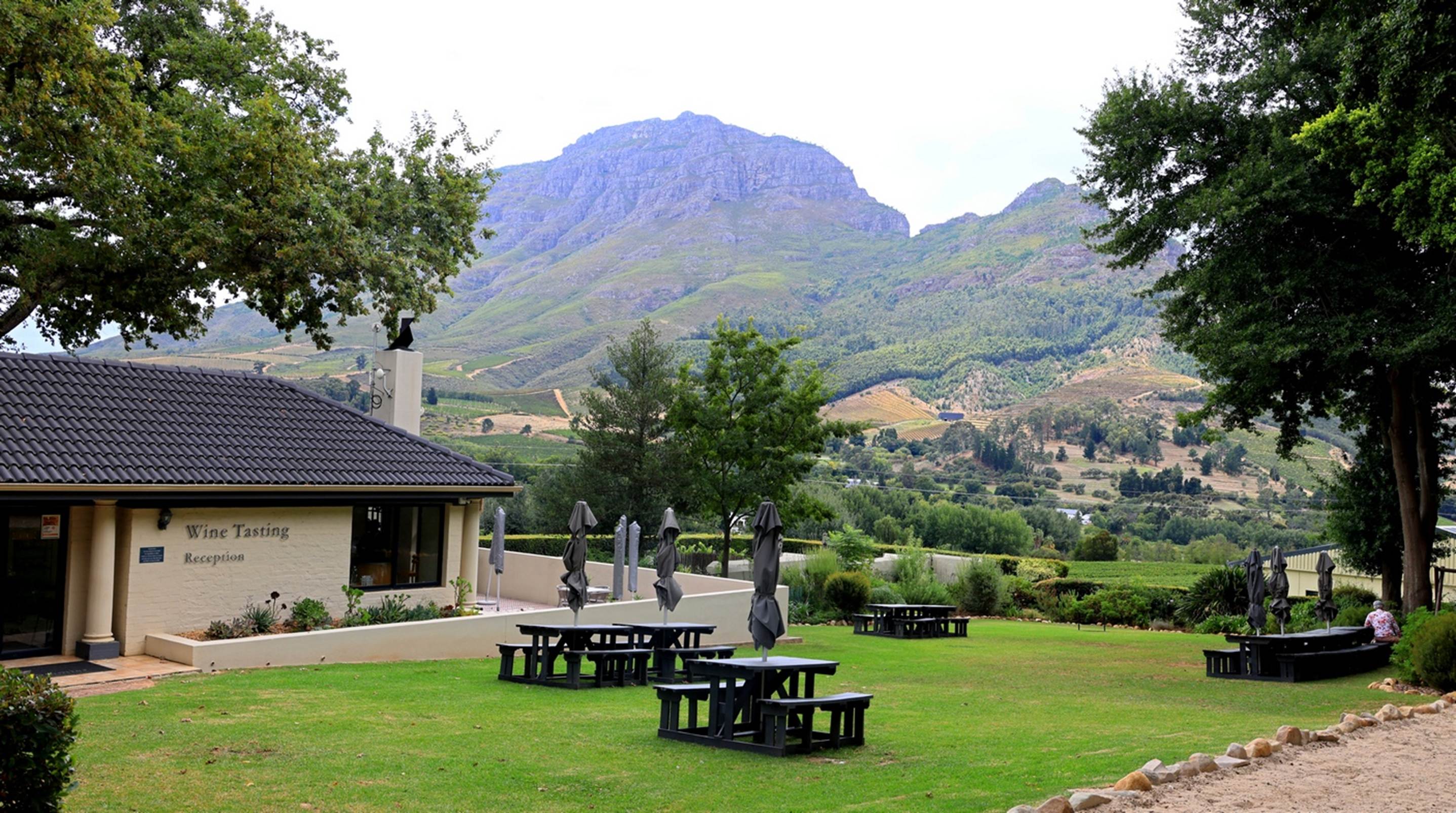
Our building for the tasting and lunch, and the view
After leaving Le Pommier, we rode a short distance and took a quick driving tour of the town of Stellenbosch, one of the first towns established in South Africa. It appeared to be a potentially interesting little town to visit more thoroughly. Besides, there were several wineries and tasting rooms there!
Muratie Winery
The Murati winery is a bit different. First, it is old, having been started in 1685 when the land was granted to the then owners by the then governor of the Cape of Good Hope. Also, the current owners/managers take advantage of the age and emphasize it in the “interior (and exterior) decorating”.
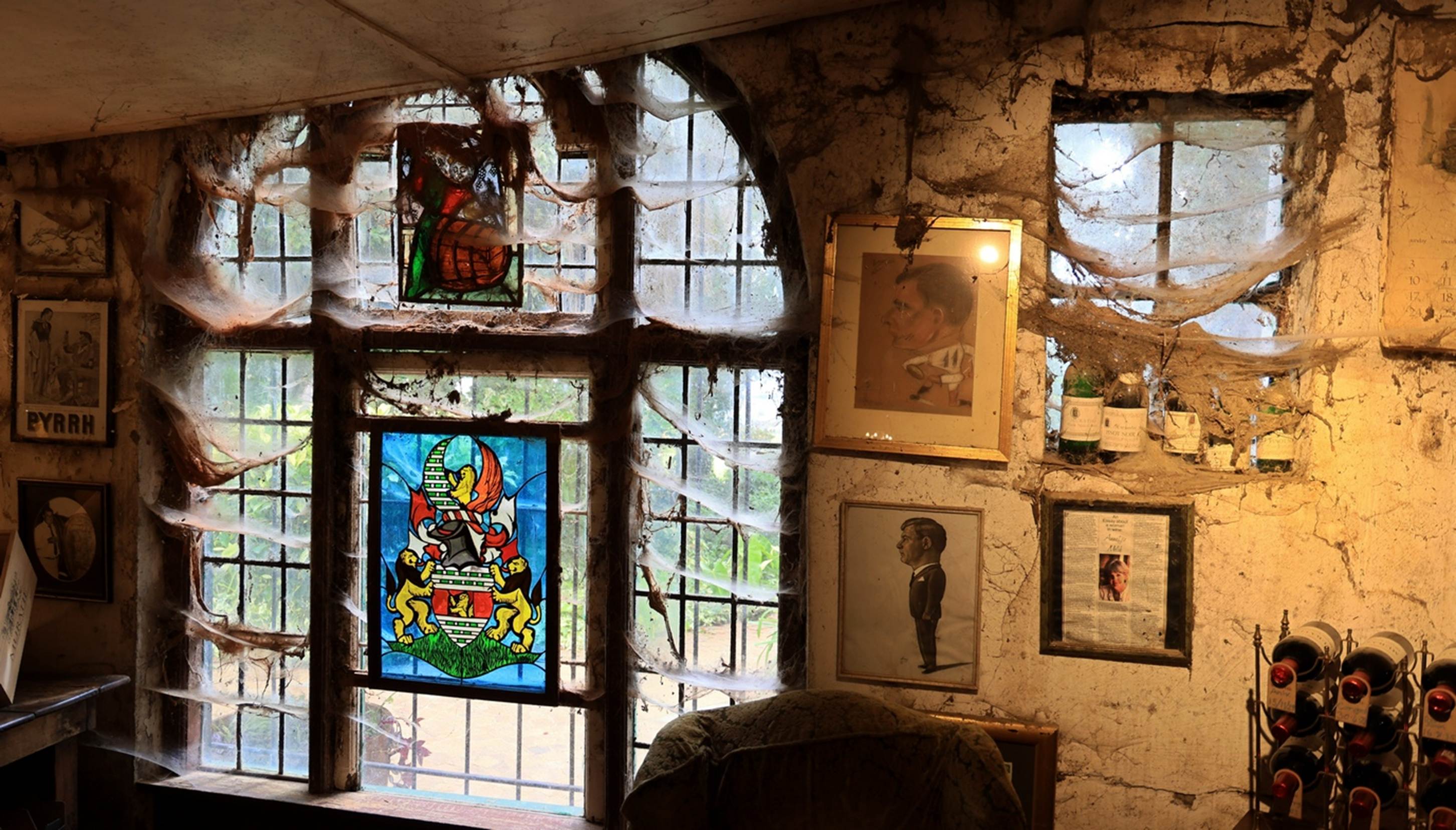
I guess this is a “History Wall” at Muratie
The people running the winery said that the cobwebs in the photo above are real and that all the decorations on the walls are actually as old as they look. We looked around the old buildings and some machinery, then enjoyed a relaxed tasting around a table outside. (Some of our group did not want to ingest anything while inside the building.)
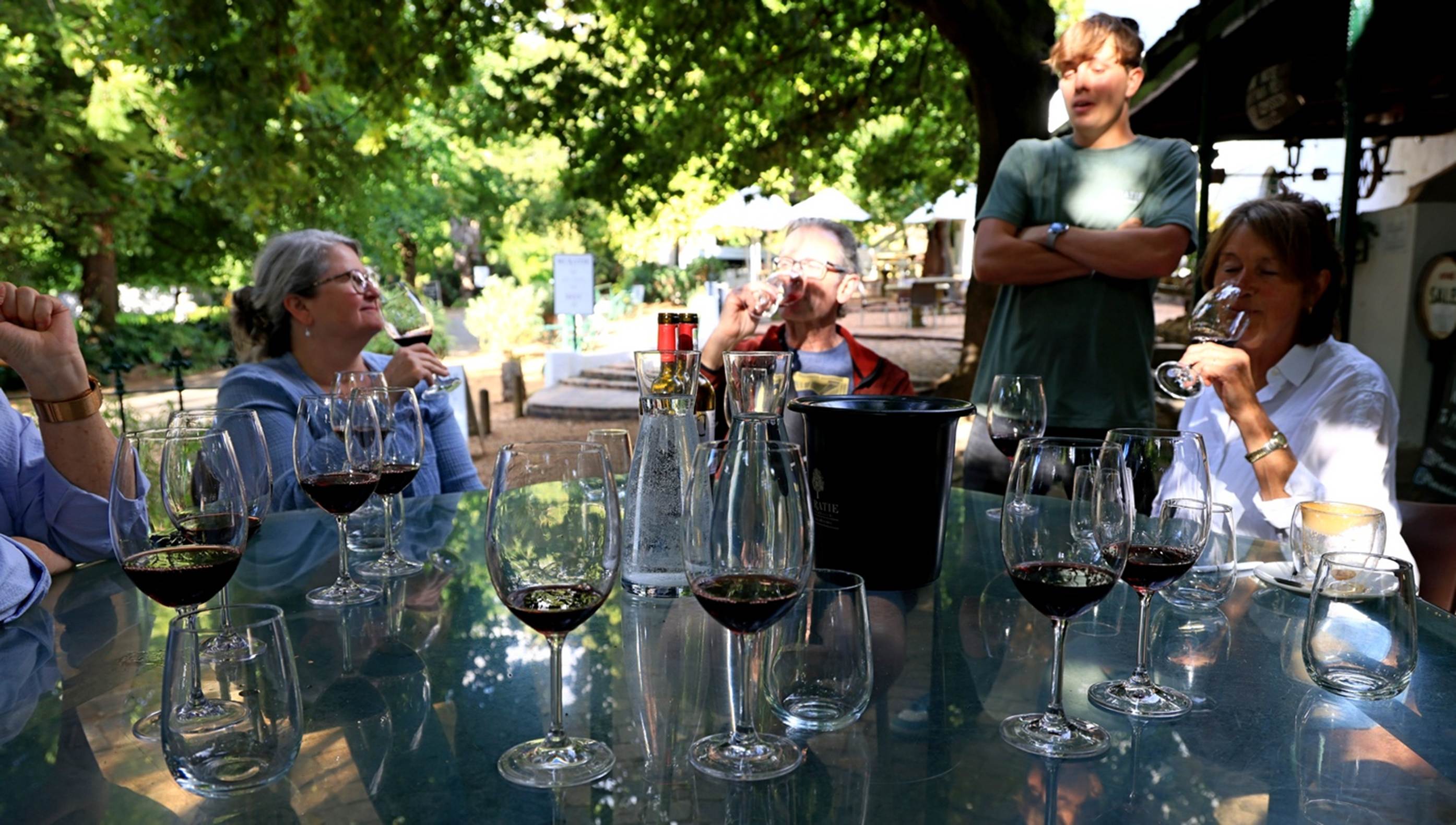
Finding out about their wines
When we finished the tasting, it was about 5:30 and our driver/host mentioned that we were about 45 – 60 minutes from downtown Cape Town and our hotels. I quietly mentioned to him that we were supposed to be at our reception at 6:00 and things got moving a bit faster. Traffic was pretty heavy but he did drop us off first at about 6:30 at the Cape Grace Hotel. We didn’t even stop by our room but went directly to the reception room and apologized for being late. When we explained that we had been on a wine tasting tour that ran late, everyone understood. We met the other participants in the tour as well as the tour guide/manager/director, Kirsten Keun, a native of Cape Town. The reception included some fairly heavy nibbles and, of course, wine, so by the time it was over and we headed to our room, we once again did not feel like we needed anything else to eat and called it a night.
Saturday, March 7: Seeing the sights of Cape Town
The itineraries for Saturday and Sunday were somewhat modified from their normal sequence because there was to be a huge bicycle race in Cape Town on Sunday which would close many streets and make the normal routes impossible. So, instead of visiting Table Mountain on Sunday, we all got an early start and added it to the front end of Saturday’s agenda.
We got an early breakfast at the hotel, then an early start (7:30), loaded on the bus and headed for Table Mountain. You may ask “Why is it named Table Mountain?”. Check the photo below.
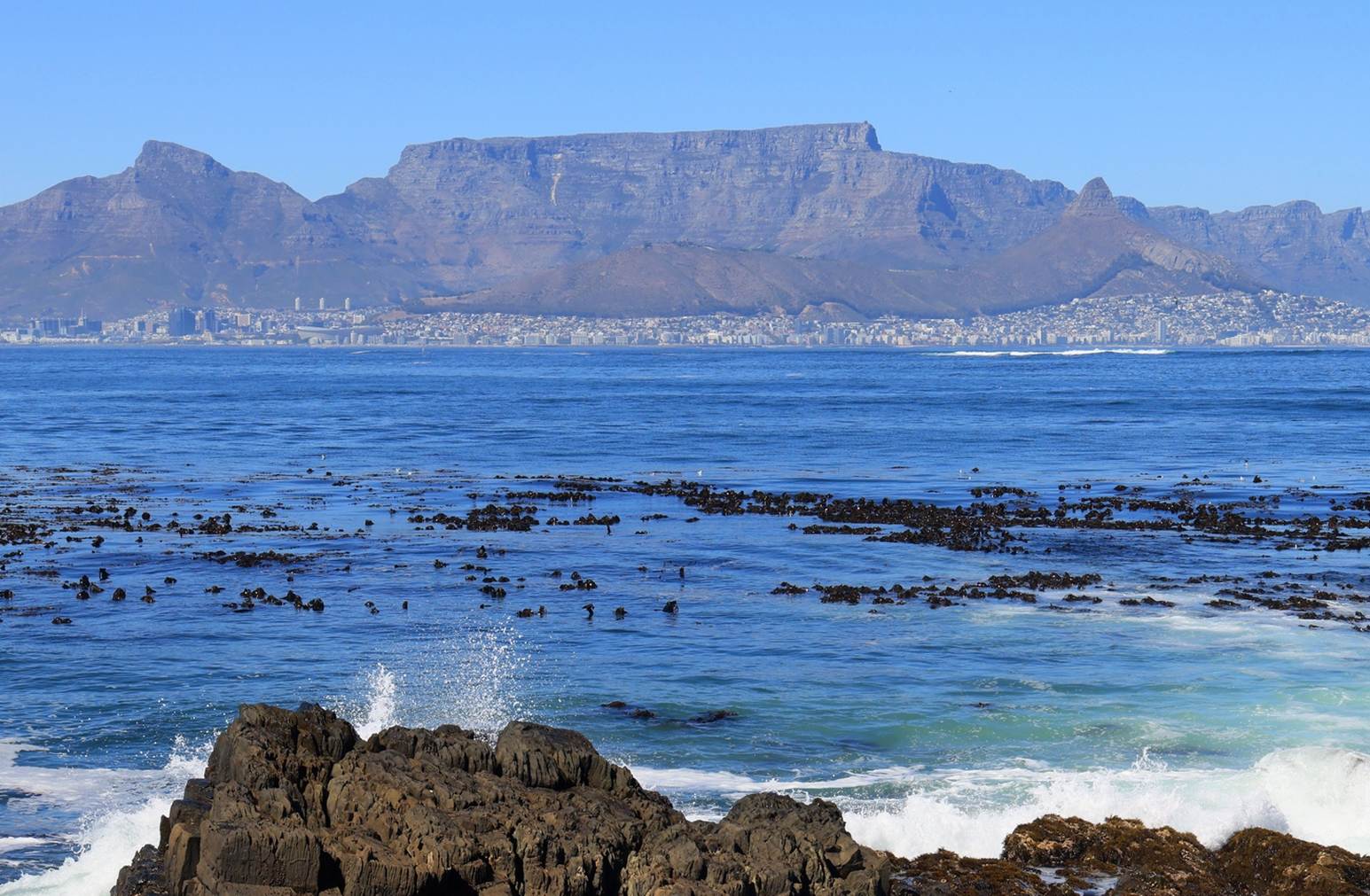
Table Mountain, as seen from Robben Island on Sunday
I don’t know, but I think a better name might have been “Pancake Mountain”, as in “Flatter than a pancake”. On the way t Table Mountain we passed by other “large hills” in the area, proving that Table Mountain is not the only mountain around Cape Town. We’ll see several more before the day is over.
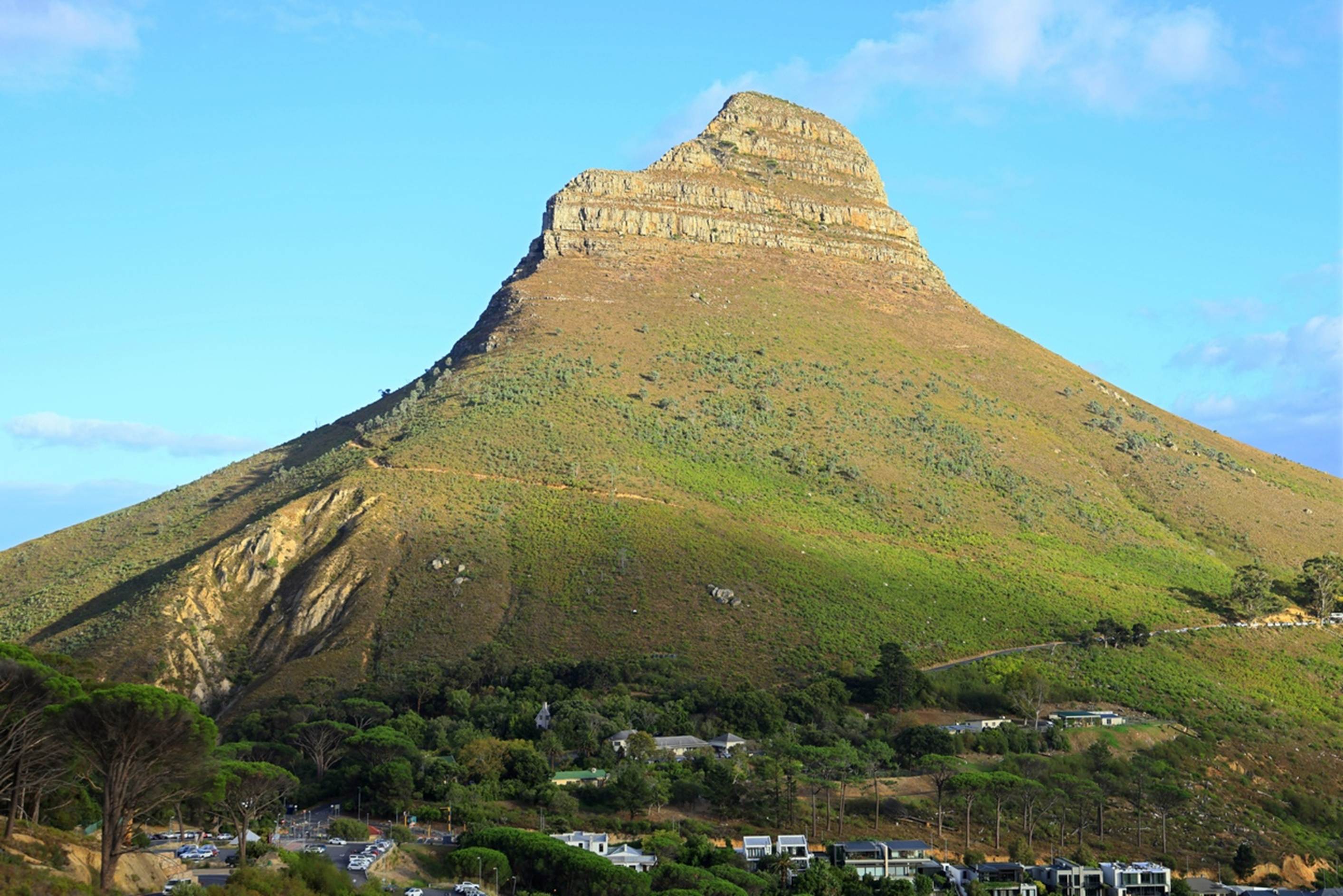
This mountain is “Lion’s Head Peak”.
We continued on around to the Table Mountain lower cable car station, which itself is already fairly high. From the observation area here, you can look up at the top of the mountain, or back the other way at the city of Cape Town

Looking up Table Mountain at the cable cars in motion
Notice in the photo above that the cable cars are just passing each other: that means they are at the half-way point up the mountain. It gives you an idea of just how mch higher the top of the mountain must be.
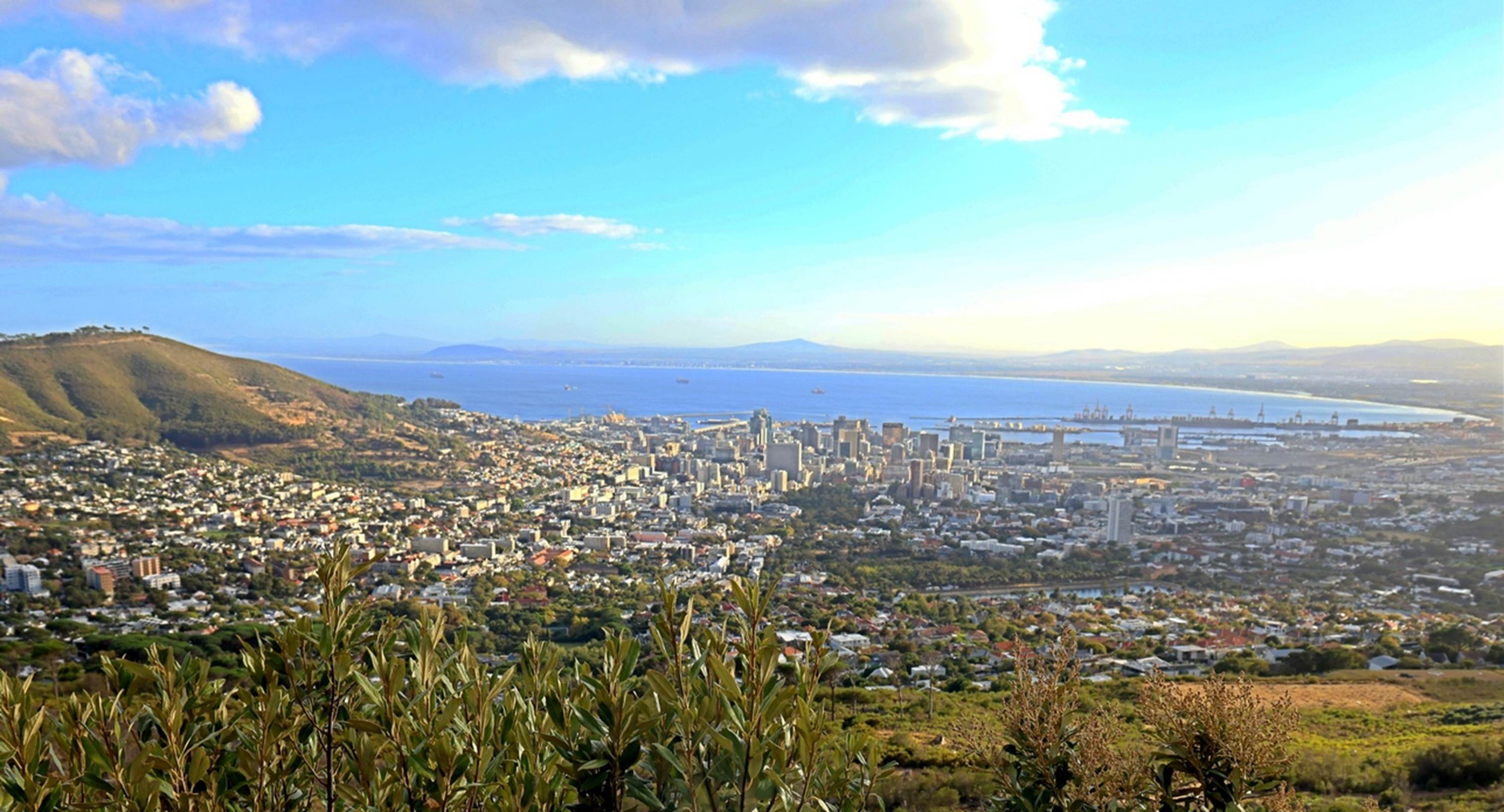
View of Cape Town from the lower cable car station
I thought the view of Cape Town was pretty good from the lower station, but it was going to get better. The cable car gondlas were a little unusual: the cab section is round and inside the gondola, the floor rotates, giving everyone a view in all directions during the ride. Unfortunately, it also tends to make taking photos or videos more difficult so my photos from the ride are limited.

A round gondola and a rotating floor
Each gondola is fairly large so all of our group (of about 18 at this point) were able to get on at one time. We all rode to the top of the line, got out of the gondola, walked out of the station, and I think we all had the same immediate thought….

Yes, a beautiful view, but a cold one
… it’s COLD up here! The 3500 foot height of the mountain meant that the air was about 20 degrees colder than at the base and the wind was blowing 20 – 30 mph, so you really felt the cold. We had gone from a pleasantly “crisp” morning at the hotel, to a frigid morning on top of the mountain. Kirsten said that he would take us on a quick tour and we would only be on the top of the table for 15 or 20 minutes. In the photo above, you can tell the difference from the view at the lower cable car station. At the extreme left of the photo you can also see Robben Island, which we will be visiting the next day.

Looking South, toward Cape of Good Hope
Looking the opposite direction from Cape Town, we could look south, along the coast line and toward the Cape of Good Hope. You could not actually see the cape from here, but we would see it up close in a little while. After getting a good (cold) look around, we headed back to the upper cable car station and waited for a ride down.
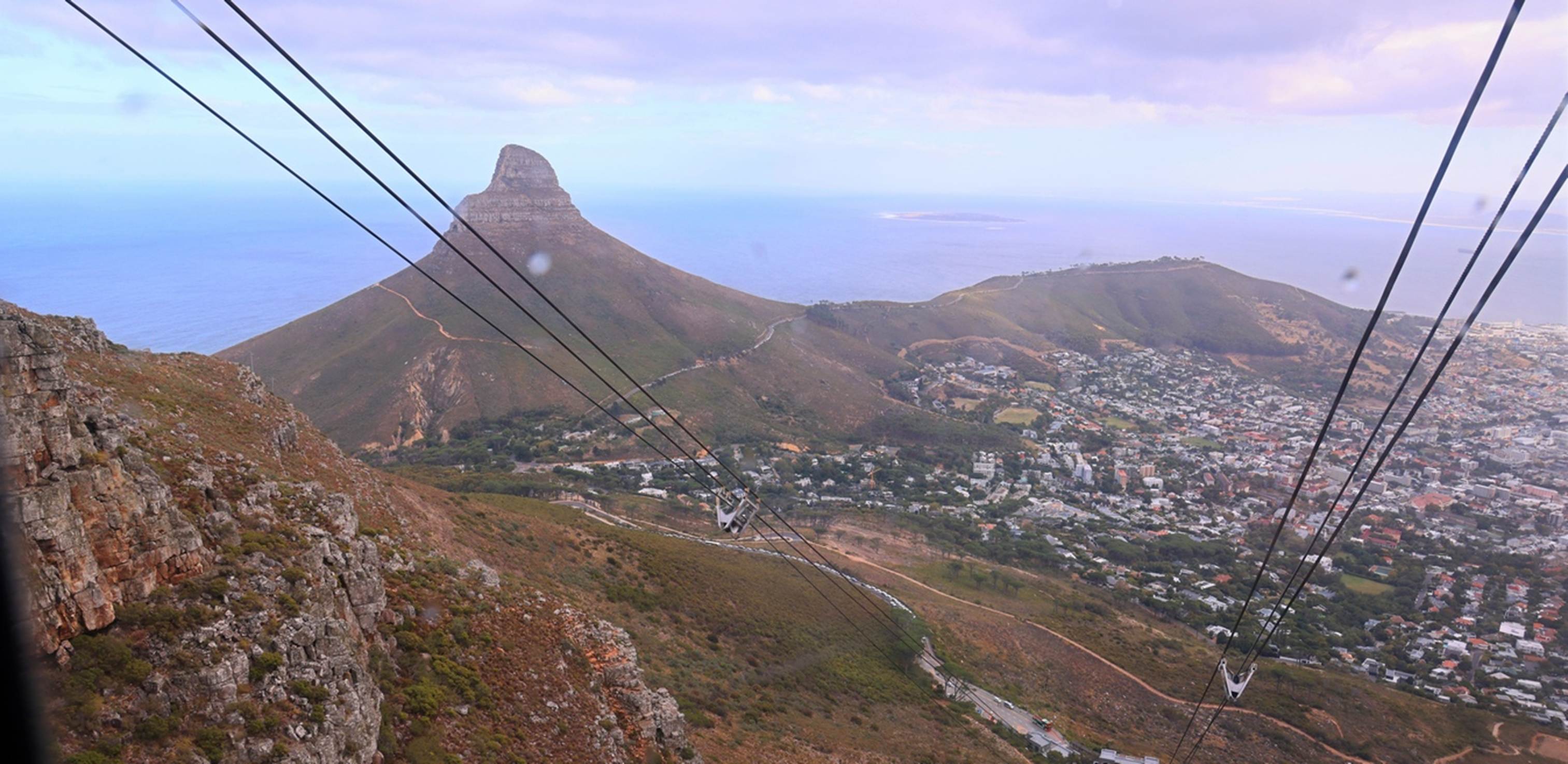
On the way back down
The initial departure from the upper station was a bit exciting and I’ll provide a video of that in a little while. When we got back to the lower station we found our bus, reloaded, and headed south toward the Cape of Good Hope, stopping occasionally for photos or for Kirsten to tell us something about the area.
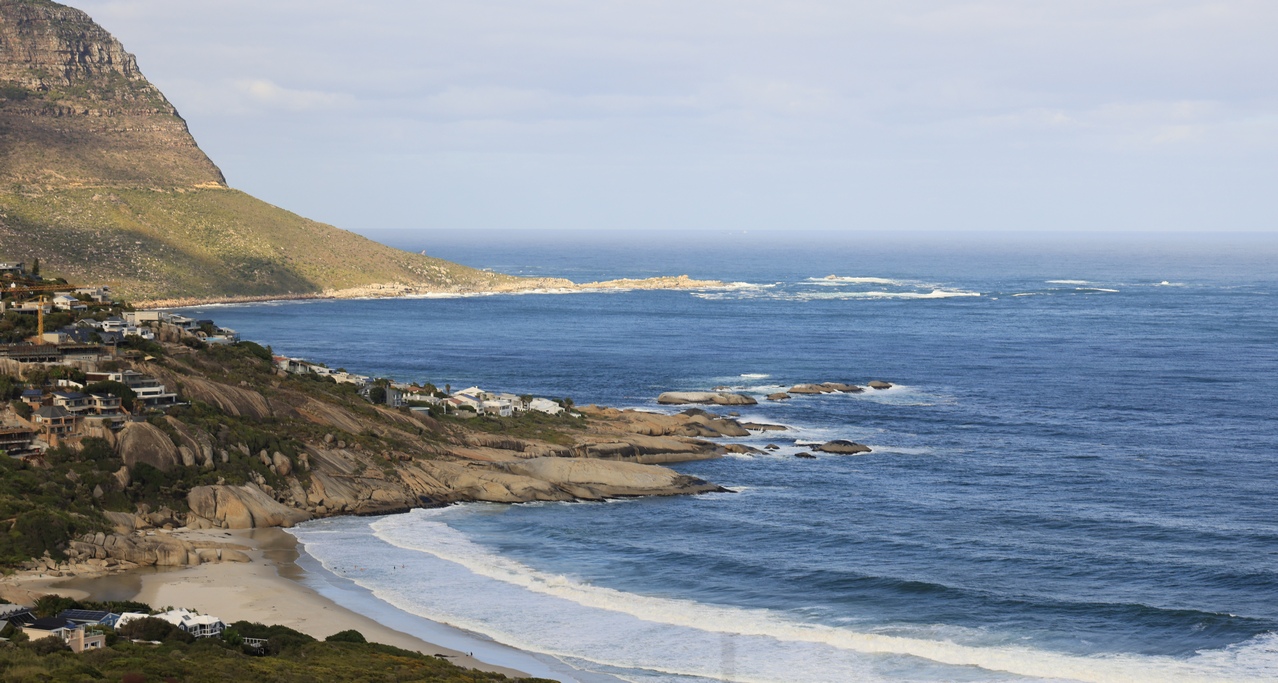
One of the numerous small bays and beaches along the way
There were several picturesque bays and little beaches along the way, although, somehow, the water always looked cold to me.
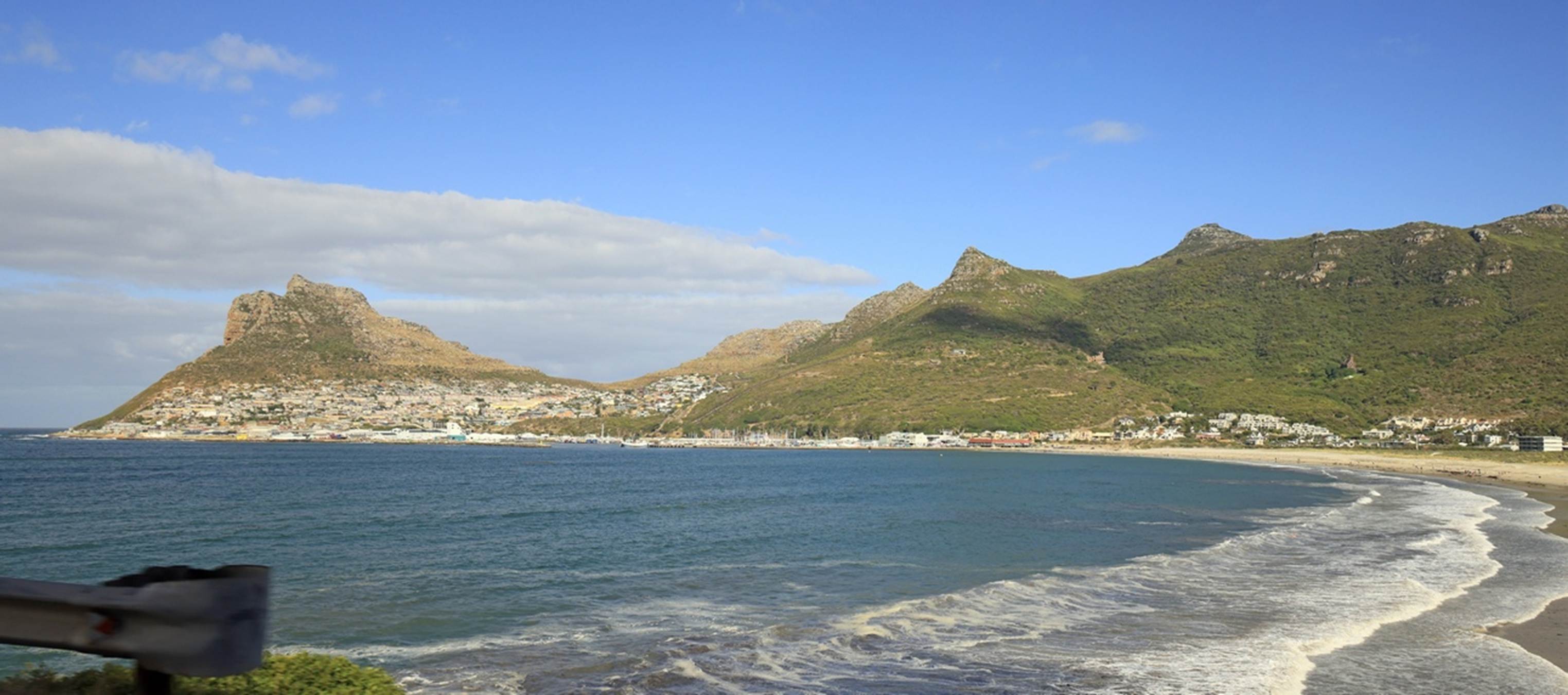
Another nice beach with a small town on the opposite side.
Kirsten lived not far from this area and he said he had surfed several of these beaches in the past. After about a 90 minute ride, we arrived at the Cape of Good Hope.
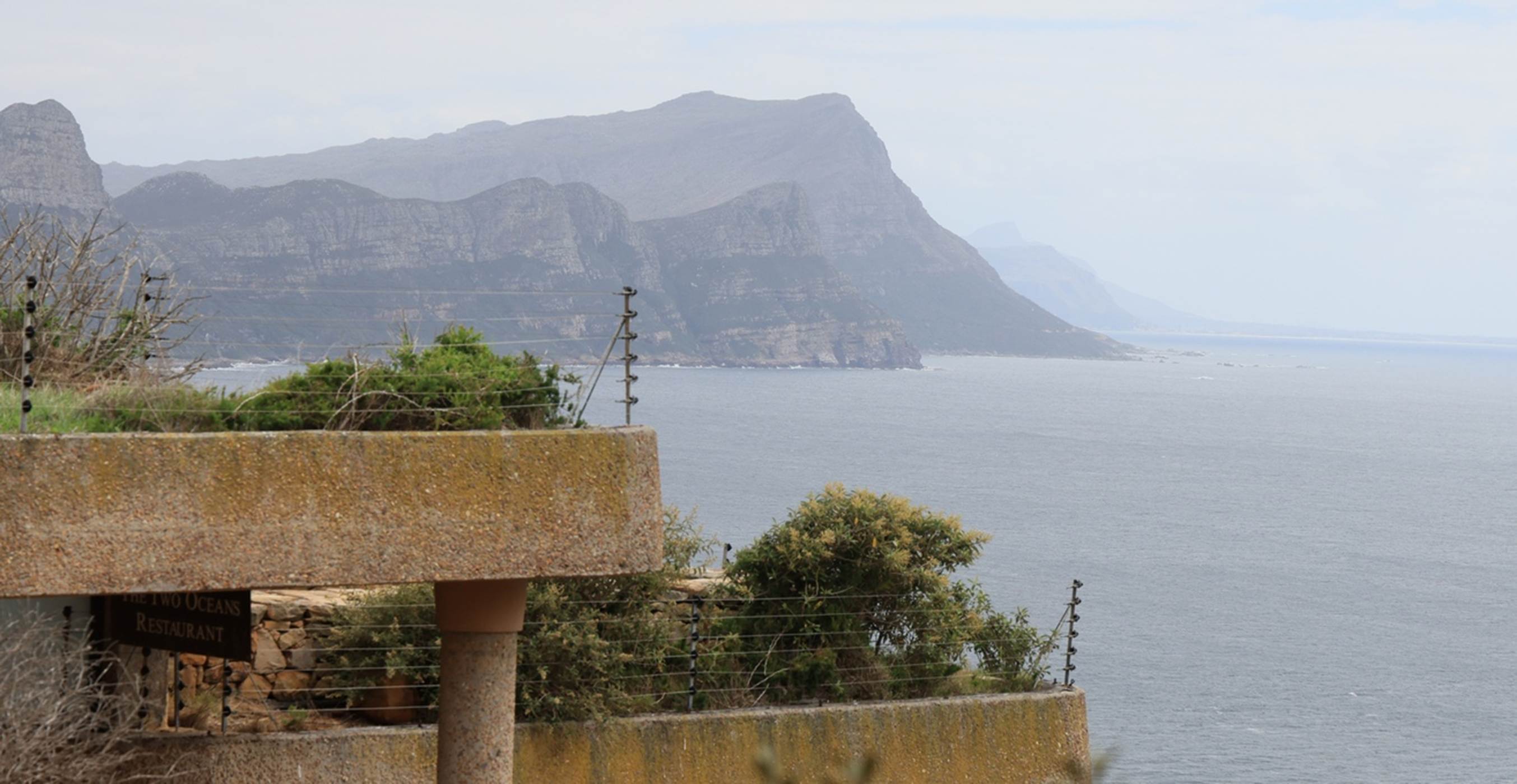
At the Cape of Good Hope, looking back north
The cape is at the southern point of a peninsular that runs south from the Cape Town area. Full Disclosure: despite what most information about the Cape of Good Hope implies, it is not the southernmost point of Africa. The coastline of South Africa runs roughly east-southeast for another 200 miles of so, where the true southernmost cape can be found. But, that area has always been lightly populated so it was not as important as the Cape of Good Hope which was close to the first major city, Cape Town. Thus, this cape got the good name and all the glory.

Looking from the top of the cape toward the visitor center
At the small mountain that forms what is considered the tip of the cape, there is a visitor center at “street level” with a “funicular” (incline railway) that runs most of the way to the top. From the funicular station you have to walk another 40 or 50 feet (vertical distance) to the very top where the historical lighthouse is located.

Susan is checking the view from the top.
In the photo above (and the one below) the point of land you can see in the distance is the very southern tip of the cape.
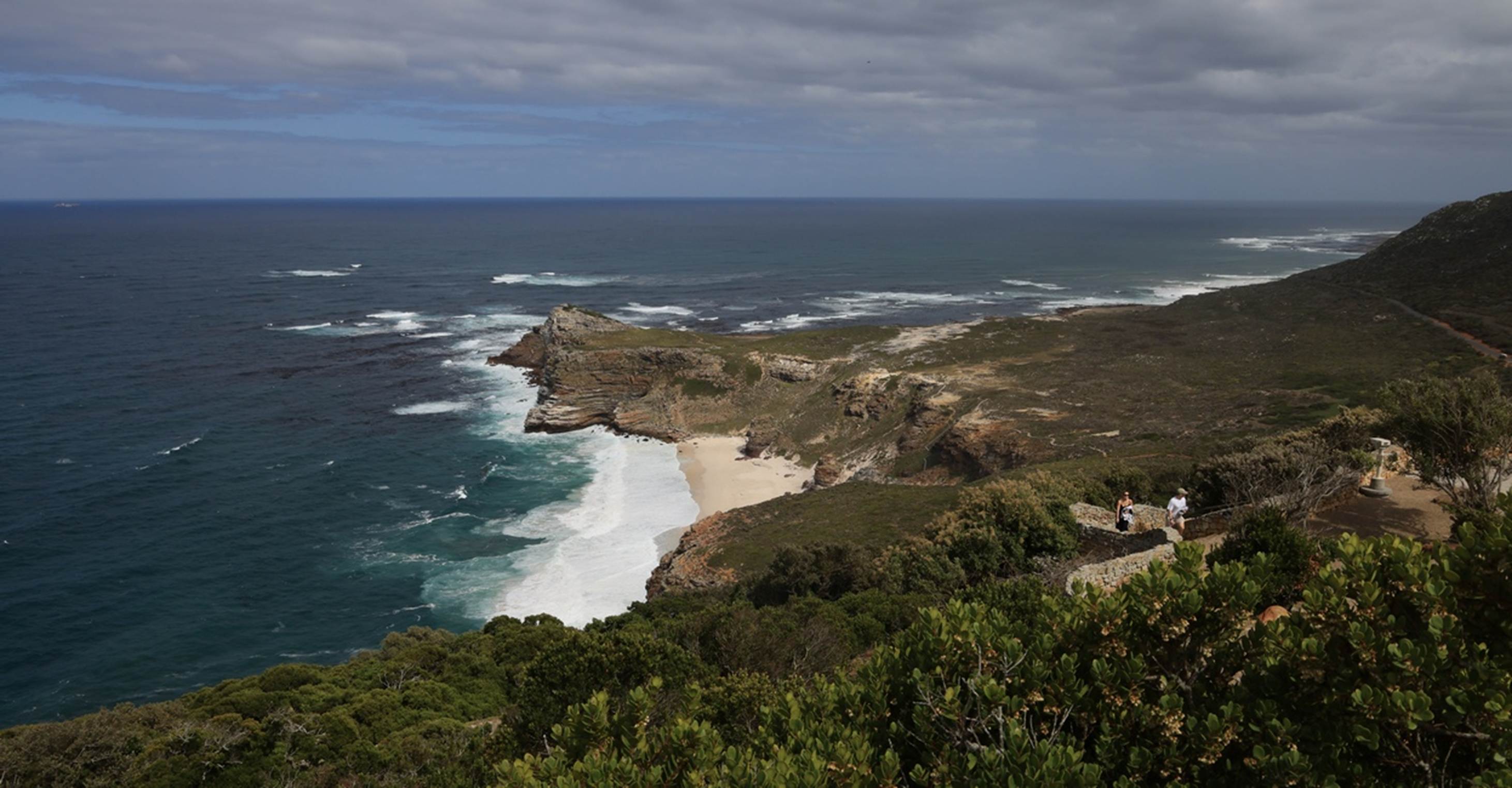
The southernmost point of the cape… or is it?
In the photo above, you can make out a small piece of another point of land in the very upper right of the photo. This is another point off of the same piece of land as the one directly in front. If you look at a map, the two points are almost exactly equally “south”, so which one is the cape? The one in the distance is the one that ships would round last before being able to head into the bay at Cape Town, so on that basis, it probably gets the title.
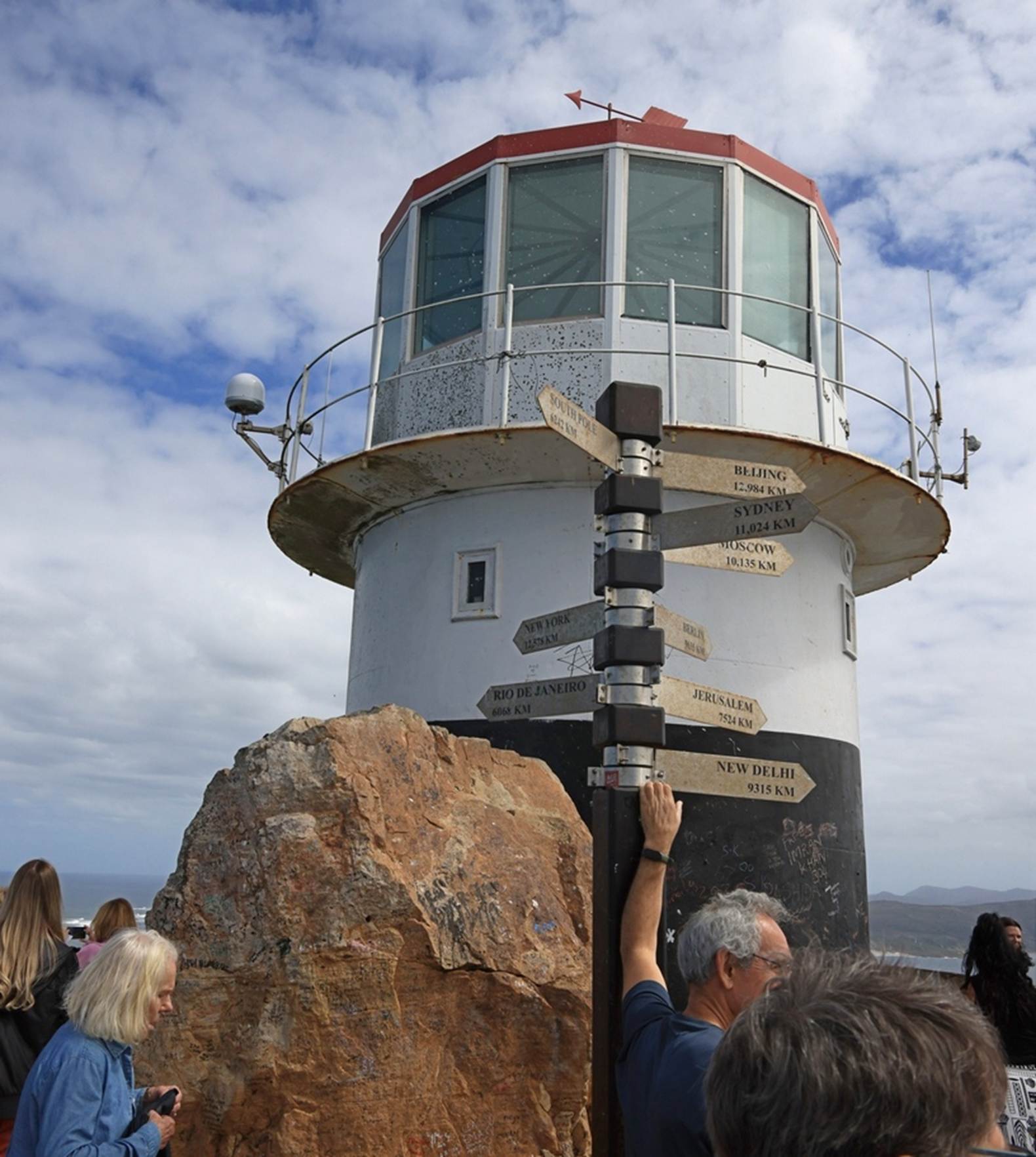
Cape of Good Hope Lighthouse
But… the historic lighthouse is much closer to that nearer point of land, so you can take your pick. After looking around a while, we rode the funicular back down to the visitor center and soon headed off on our next l;eg of our tour. I was somewhat surprised to see some of the wild animals we encountered during our tour, including some Impala Antelopes, some other antelopes which I don’t remember the name of, and a family group of baboons.

This baboon sat on a rock and posed for us.
After riding for probably 45 minutes, we got off the bus and made our way down to the beach area where there were… Penguins! Now, Penguins are always cute, but after seeing so many on our recent Antarctica trip, we were not quite as taken with them as most others in our group.
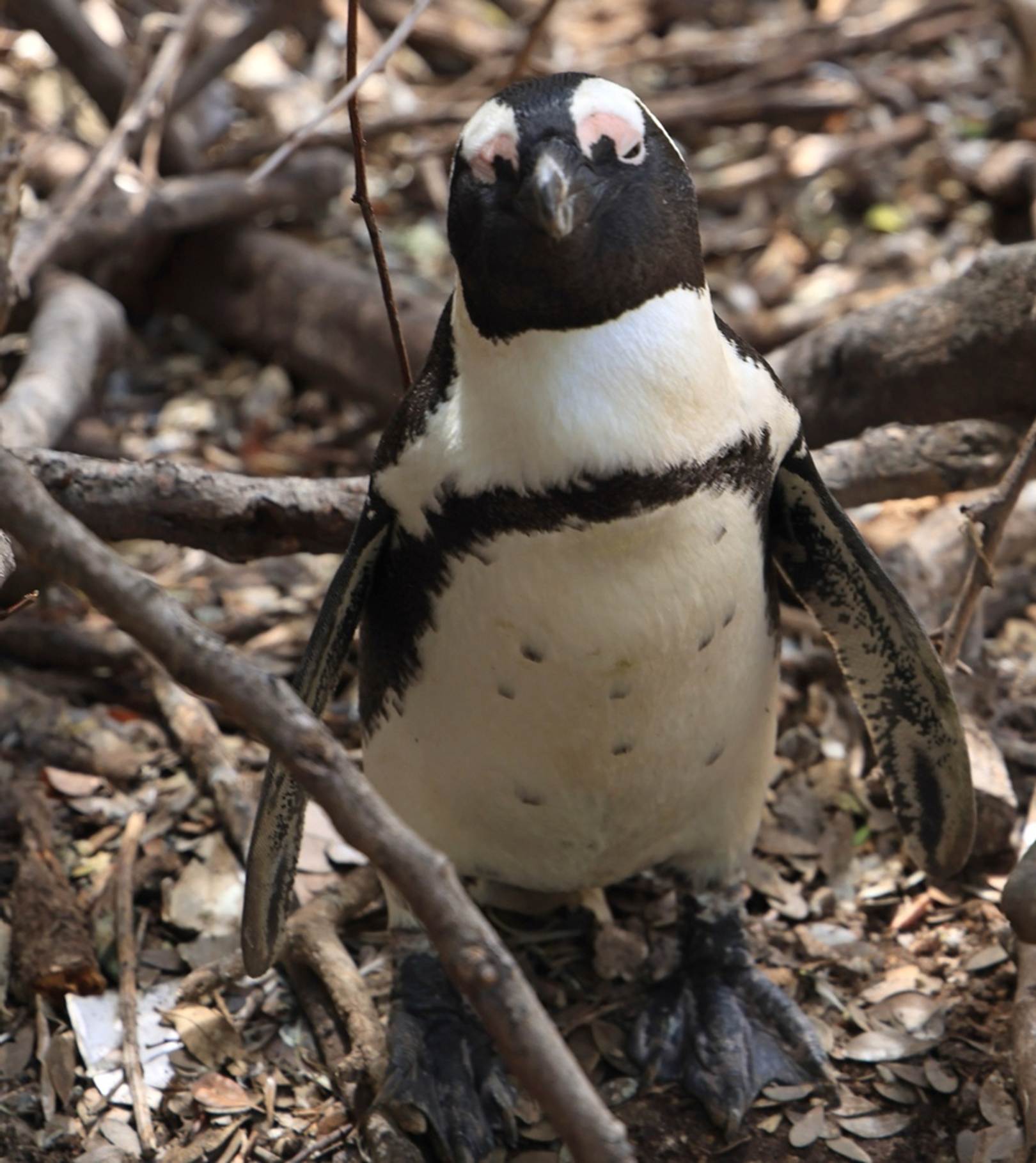
Penguins are always cute.
I did not see any pinguins that appeared to be young ones, with their grey fluffy feathers and and I did not see any parents feeding their young. All of these seemed to just be lounging on the beach and adjacent rocks where I assume they were resting between fishing trips into the ocean.

One of several groups of penguins
After observing the penguins for a while, and taking many photos, we got back in the bus and headed further back up the road to the Kalk Bay community, on the opposite side of the peninsular from Cape Town, and stoipped at the Harbor House restaurant for lunch. The lunch here would set the pattern we would see over the rest of the trip: for a group meal, it was surprisingly good, there was plenty oif it, and the service was very good. Did I mention they were very generous with the wine? Besides the food, wine, and service, I had a seat next to a large window and enjoyed views like the one in the photo below.
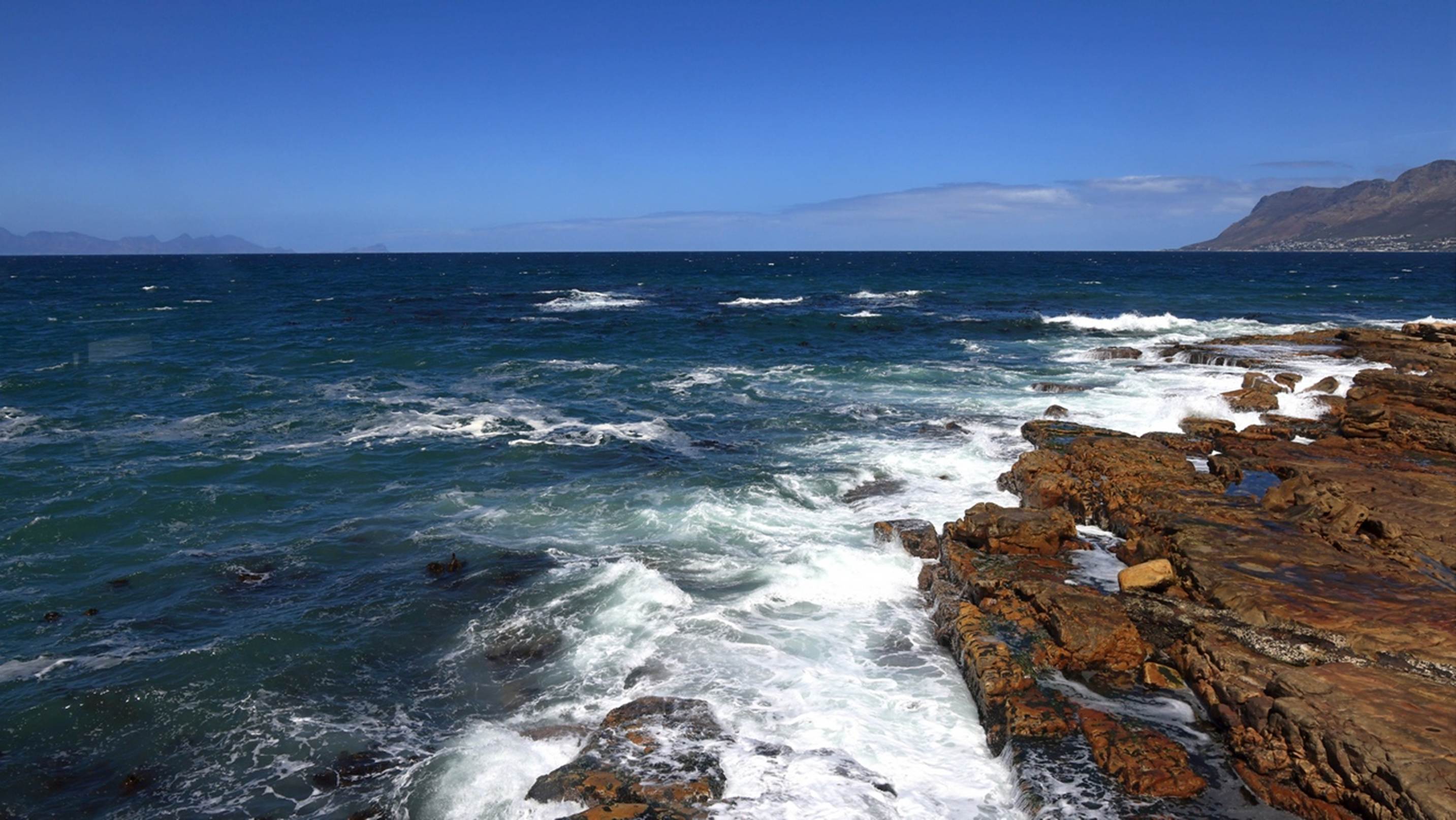
My (and other’s) view at the Harbor View Restaurant
Back in the bus, we headed toward Cape town to visit a somewhat different neighborhood: Bo Kaap. The bus driver let us all out on a street corner and Kirsten led us on a tour of the area.

Bo Kaap features brightly painted buildings
The Bo Kaap area is historically important as an early settlement which the Dutch established for colonial slaves. All the buildings were initially white, but when the slaves obtained their freedom, they painted the building in bright colors to celebrate and have maintained the custom since.

There are several mosques in the neighborhood.
The residents are predominately Muslim and there are several mosques in the area, including the first mosque in South Africa. There was definitely a different “feel” to this neighborhood, although the majority of people on the streets were visitors, like us.

Recognize that hunk of rock in the distance?
It seemed to be that everything in the neighborhood was colorful, not only the houses, but the mosques, the stores, and even the scooters.
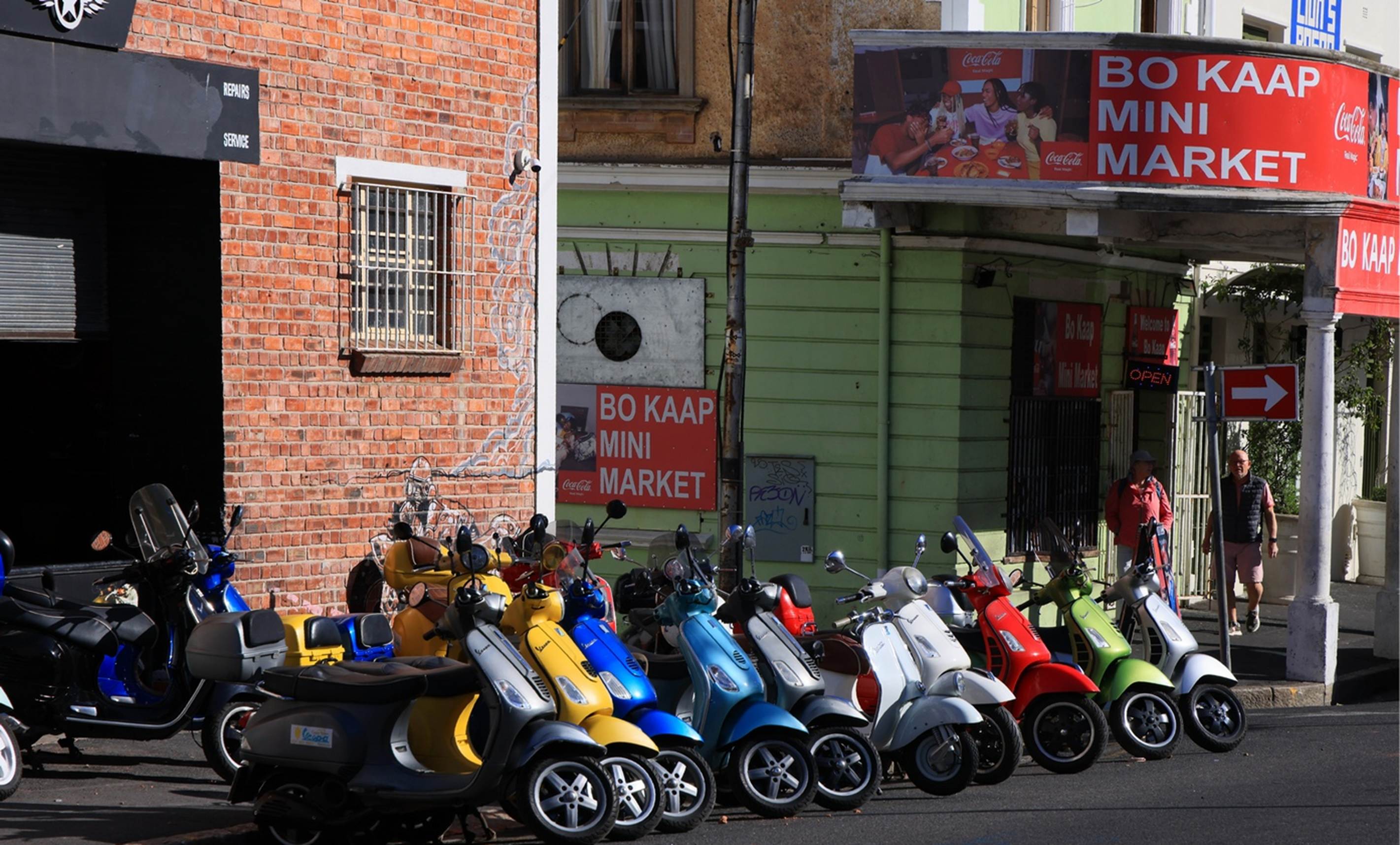
The scooters are bright, like everything else in Bo Kaap
We found the bus and it took us all back to the hotel for the evening. It probably will not surprise you that, once again, Susan and I were not hungry at dinner time. We decided to just munch on some snacks we had and call it an evening.
Now, If you’d like to see a quick review of the day, and some videos of the cable car and funicular that I did not put in the narrative, I suggest that you click on this link: Cape Town Sightseeing. It will take you to a four minute photo/video “slideshow” of the day I put on YouTube so you can return and refresh your memory any time. ( https://www.youtube.com/watch?v=gij0LVbXEyc )
Sunday, March 8: Visiting Robben Island
When traveling, some things you do because they are fun, exciting or scenic and sometimes you do things because they are informative, educational, and something you need to do to understand the world and history better. Today’s primary activity was of the latter type. We would be visiting, and getting to understand better, Robben Island, where Nelson Mandela was imprisoned for 18 years, along with thousands of other political prisoners.
We joined our guide, Kirsten, for the 15 minute walk from the hotel into the marina area where the Robben Island Museum was located and where the ferry to the island departed from.

Outside the Robben Island Museum
We boarded the ferry and were soon joined by our special guide for the day, Christo Brand. Brand had become a good friend of Mandela while in the prison, but the relationship was a little strange: Brand was a prison guard responsible for guarding Mandela. Mandela was already at the Robben Island prison in 1978 when Brand srarted work there when he was only 19 years old. In 1982 Mandela was transferred to Pollsmore Prison and Brand was sent there also. They remained close friends until Mandela’s death in 2013. Brand had written a book about their time together, “Doing Life with Mandela: My prisoner, My Friend”.

The ferry that took us to Robben Island.
If you remember one of the photos of Cape Town from the previous day, you can see that Robben Island is a couple of miles outside of the port of Cape Town, In many ways, Robbin Island reminded me or our Alcatraz: a prison on an island separated from land by several miles of cold treacherous water.
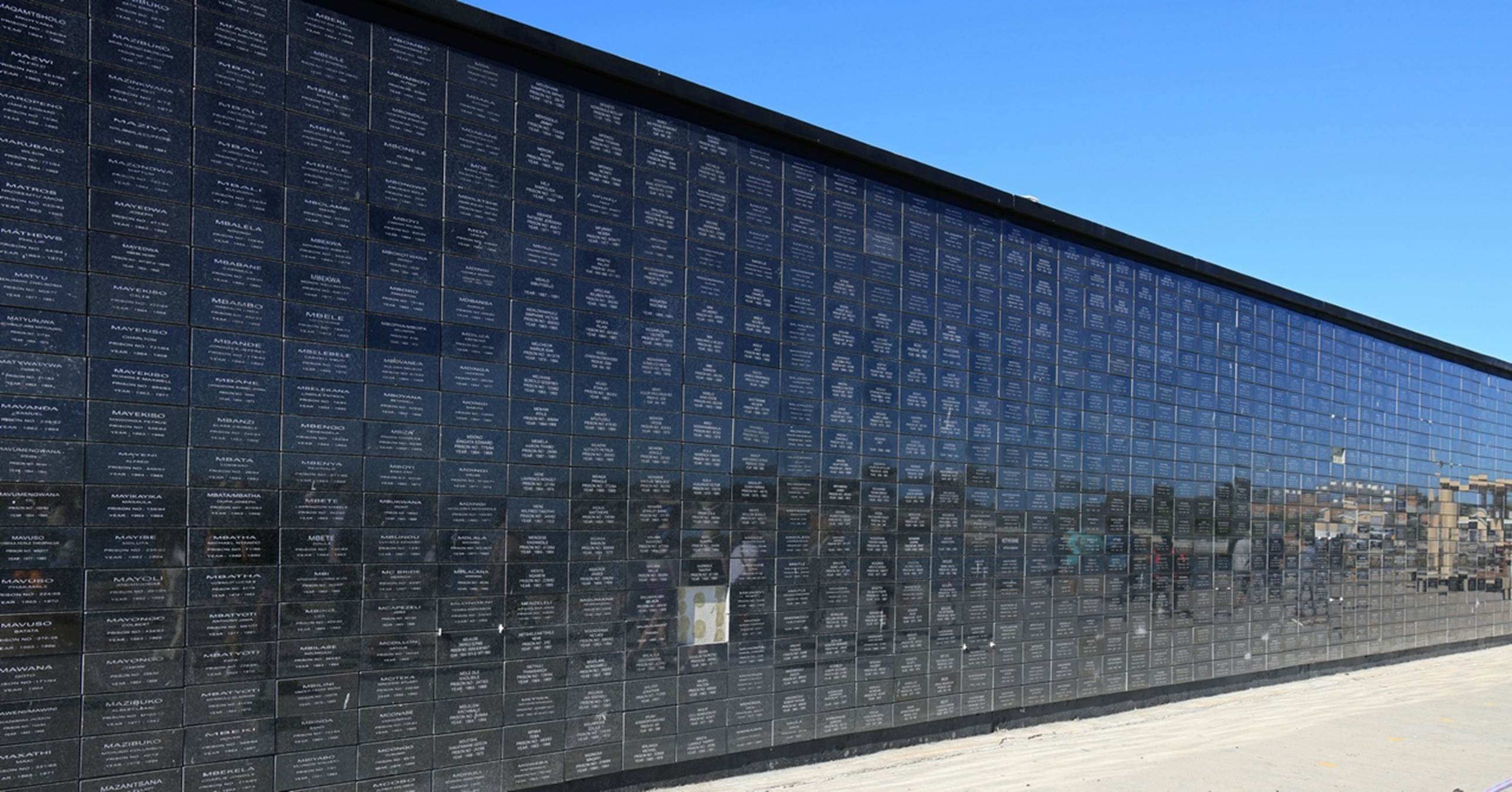
The “Wall of Remembrance”
One of the first things you see when you get off the ferry is the “Wall of Remembrance”, A wall with thousands of plaques, each with a prisoner’s name, prisoner number, and the years they were in the Robben Island prison.
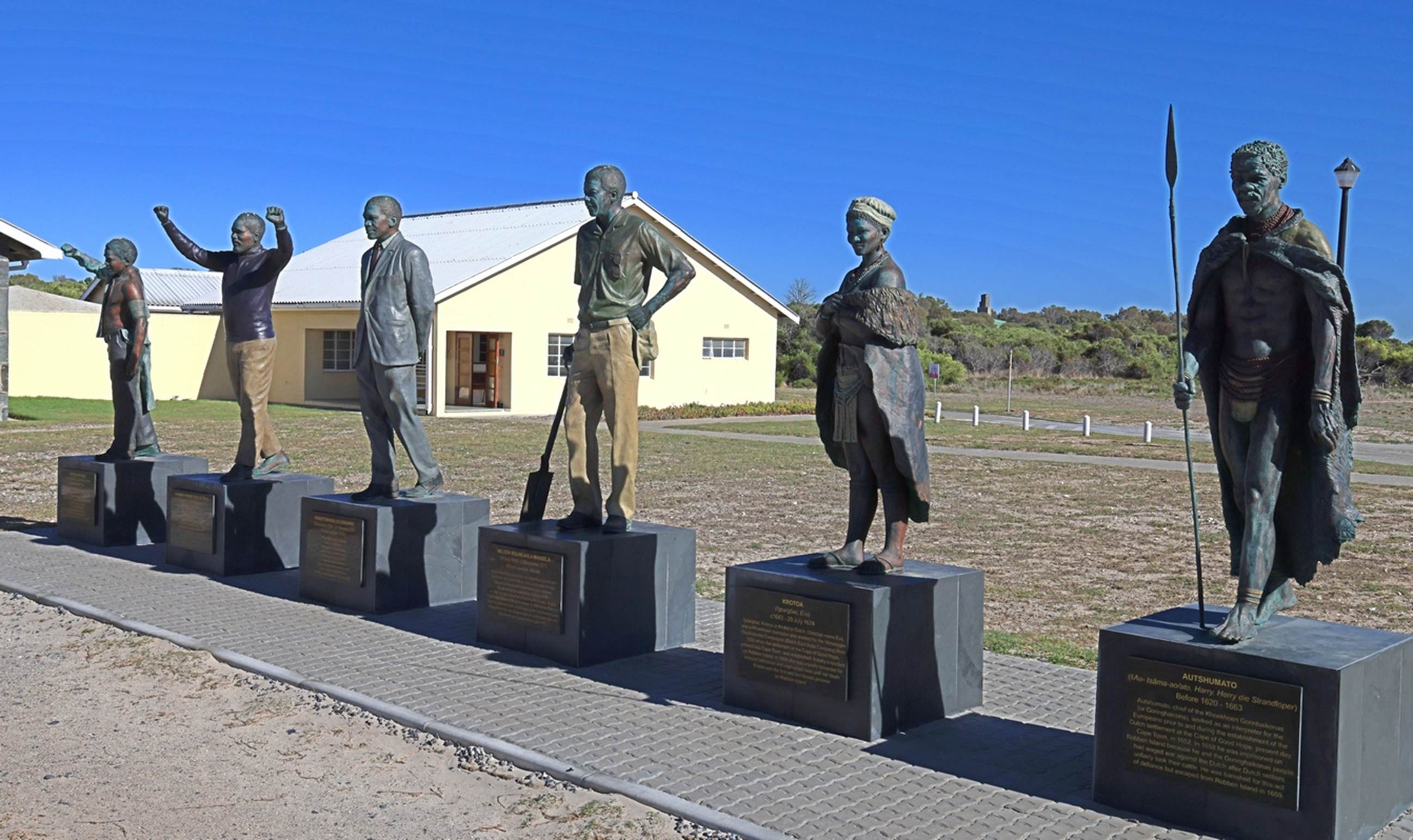
Life sized statues of African human rights activists
While most people getting off the ferrys formed into large groups and boarded busses for the standard tour of the Island, we formed around Christo Branch as he led us around the prison on foot. Between the ferry dock and the prison was a line of statues representing some of the major African human rights activists: Nelson Mandela is the one holding the shovel. A couple of these people and their actions go back to the 1600.

Robben Island Maximum Security Prison
Although the prison was named “Maximum Security”, few of the prisoners were criminals in the usual sense: most were some form of political prisoner or activist that the government wanted “out of the way”. In the photo below, the smaller man with the backpack is Christo Brand, the former guard, and the large man with the cap was a prisoner from about 1969 to 1975 (before Brand arrived): unfortunately, I did not write down his name. He was sent to Robben Island when he was 16 because he took part in a street demonstration in Cape Town. He joined us for much of our tour and told interesting stories.

Another prisnor / guard pair who have become good friends
They guided us around many parts of the prison, such as the little “phone booths” used when visitors came to talk to prisoners and the memorial to the many prisoners who died on the island. When a prisoner died, sometimes they were buried on the island (we saw the cemetery later) and some were sent back to the mainland for burial, but frequently, relatives were not notified of their deaths or where they were buried.
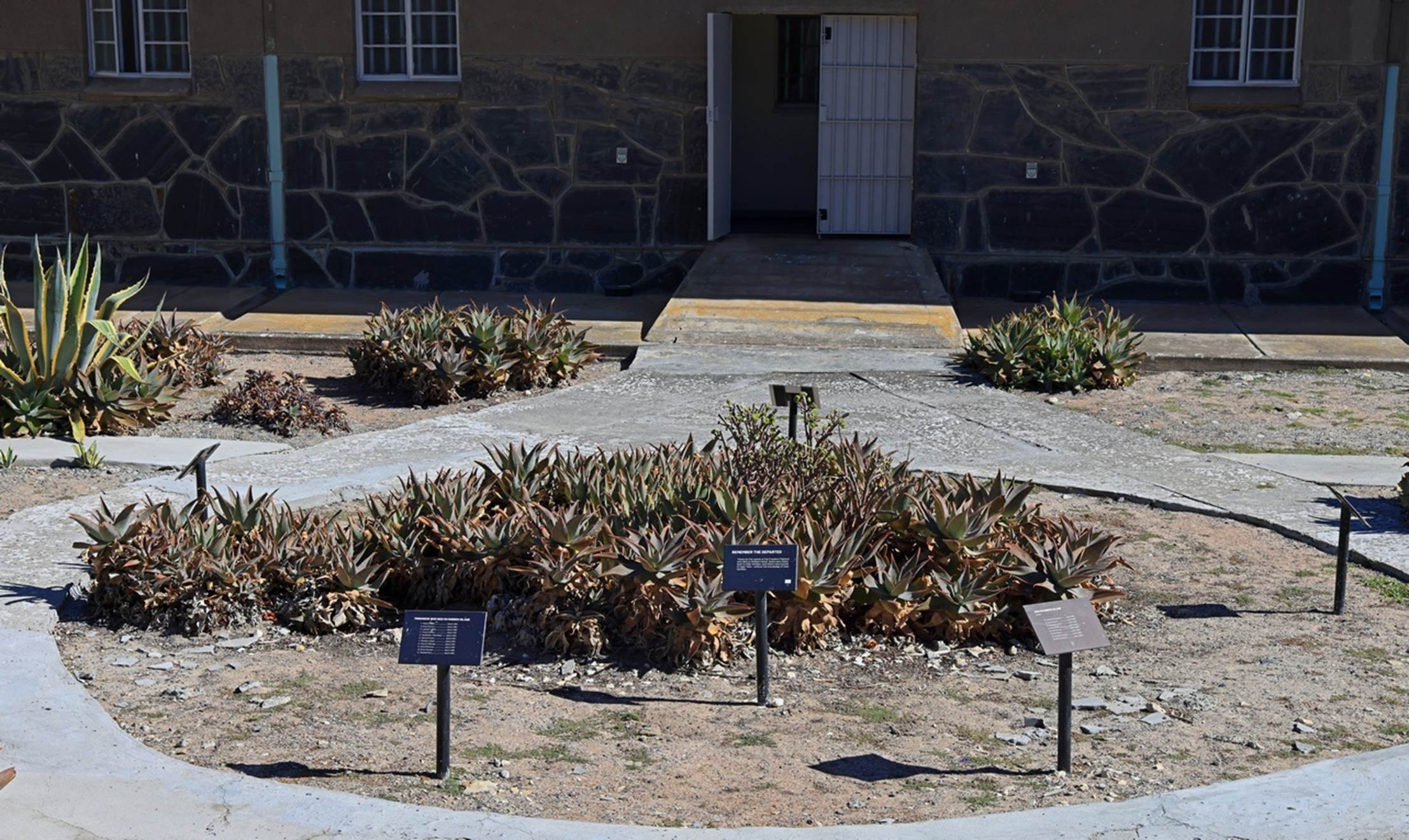
Memorial Garden for prisoners who died here (names on plaques)
They took us to Mandela’s cell for most of his stay on the island. There was barely room to lay down straight on the floor and the standard matress was basically some straw or reeds woven together.
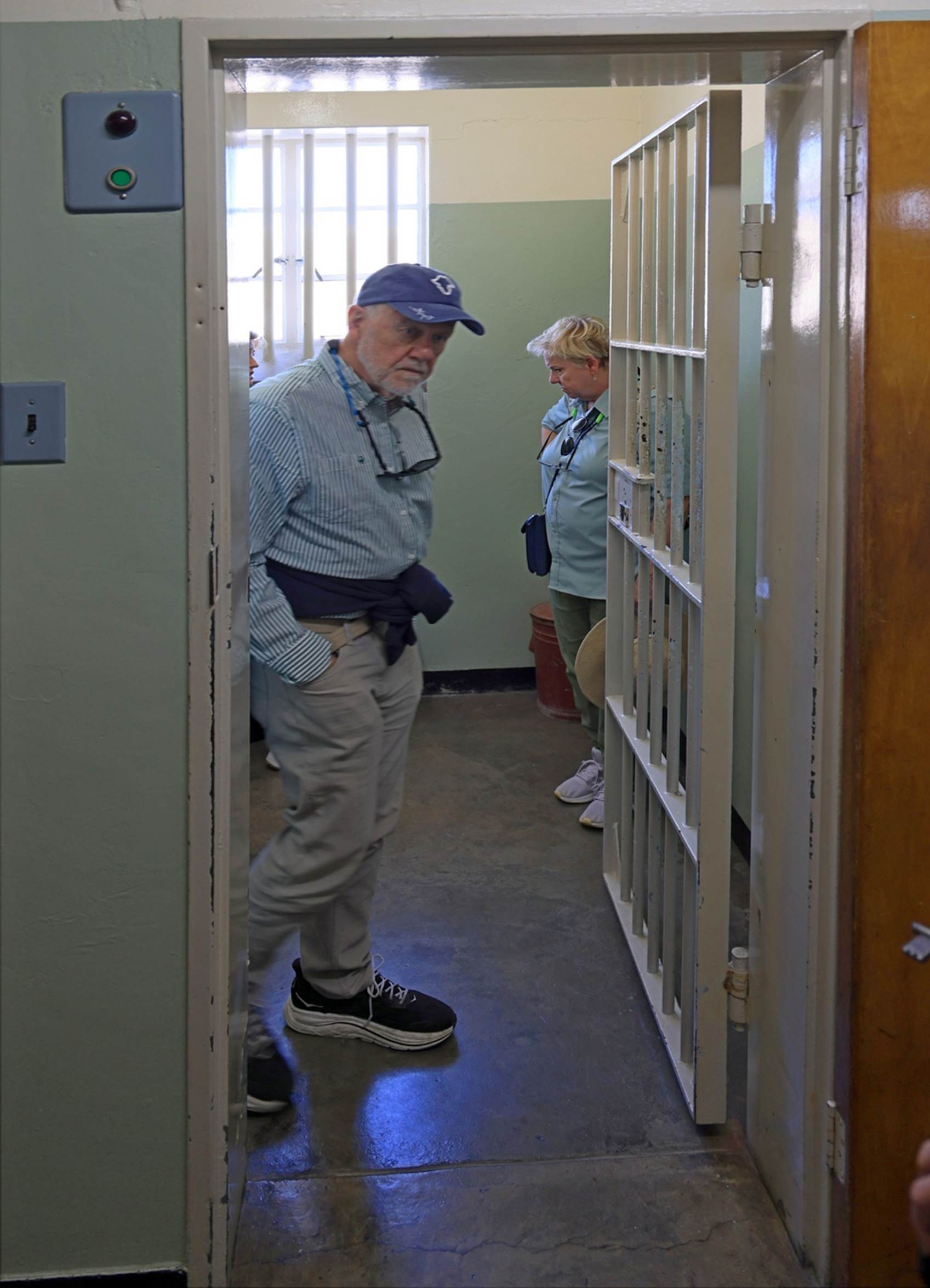
Looking at Mandela’s cell
After looking around the main prison for a while, we boarded a van/bus to see the rest of the island, almost all of which was in some way in support of the prison. At one stop we noticed a row of what appeared to be small but well maintained cells and asked about them. Turned out that they were the kennels for the guard dogs. I think it occurred to several of us that it appeared the dogs were probably treated better than the prisoners.

The Kennel for the guard dogs
A little further along, we came to the limestone pit or quarry. The limestone was quarried mainly for construction uses, either chopped/cut into blocks or ground in powder to make a form of cement. Of course, the prisoners performed all of the manual labor around the quarry, but it was not all bad news. While the work was certainly back-breaking and terribly hot, it did afford the prisoners a chance to talk to each other and exchange information and ideas and even educate each other. It also offered fresh air and a form of escape from the prison walls so some prisoners, including Mandela, looked forward to spending time in the quarry. Years later, it was to become even more symbolic of the labors of the activists.

The limestone quarry with the mound of stones
In 1995, during a reunion of prisoners, Mandela picked up a stone from the quarry and placed it on the ground close to the entrance of the quarry, saying it represented it as one of many prisoners and activists. Other former prisoners immediately followed suit, picking up their own stone and adding it to the pile, creating what is now known as the isisivane (meaning “heap of stones marking a significant spot”).
We continued around to the rocky coastline where a large kelp bed helped calm the waves and made a good place for a penguin colony. In the photo below it is possible to pick out a few juveniles by their furry grey coats.

A colony of African Penguins rest on the rocky shoreline.
A short distance further on, our driver spotted a sight that was very rare a short time ago, but is thankfully becoming more common, a Black Oystercatcher.
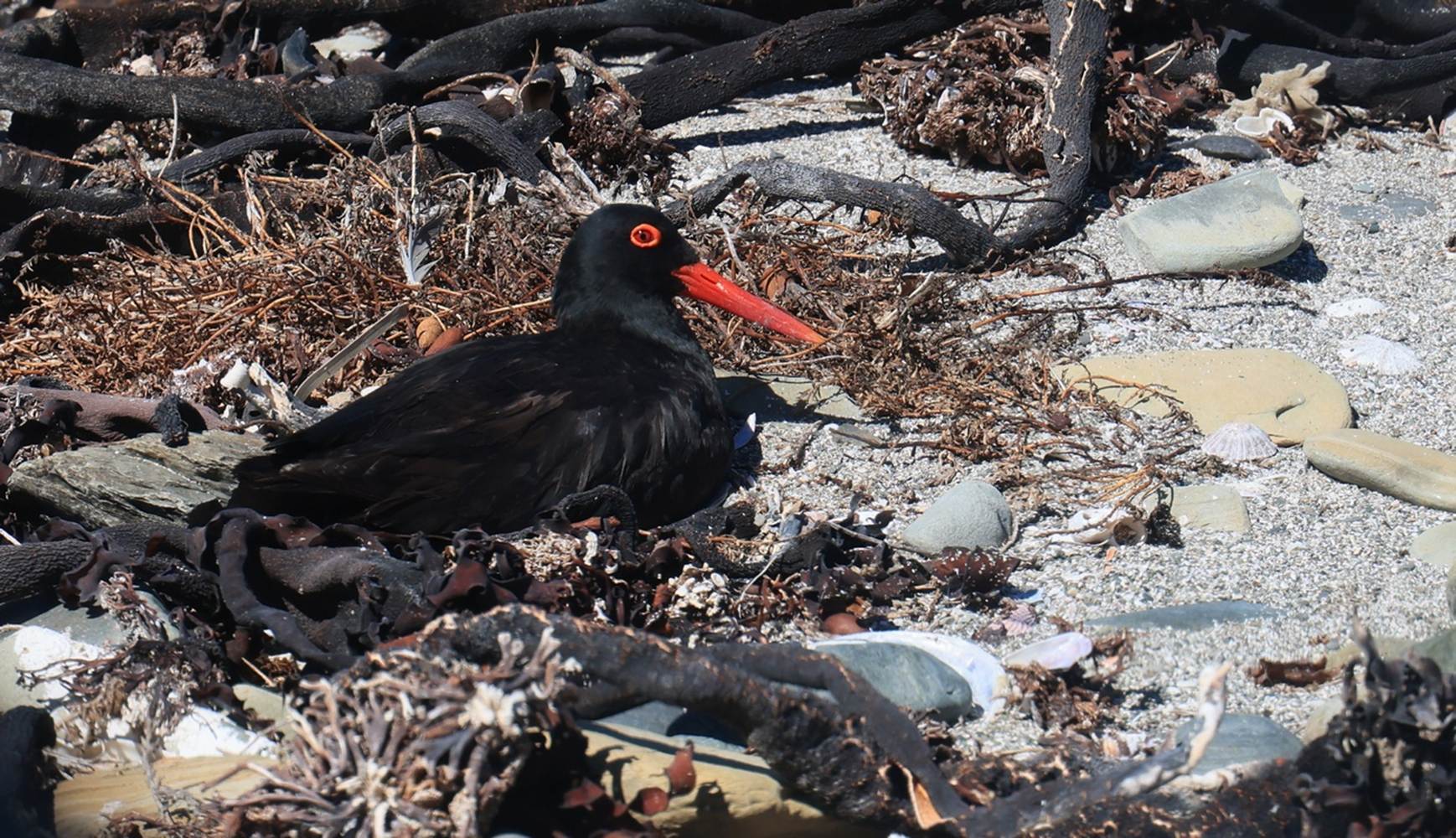
Black Oystercatcher on a nest
The Black Oystercatcher almost went extinct a few years ago, but thanks to some rather extreme protections and aids to the birds, they are making a good comeback.
We continued our bus ride around the island, ending at the ferry dock where we boarded our ferry for the ride back to Cape Town. We then made the short walk over to the Victoria Wharf area of the marina and I was a bit surprised at the number of restaurants and other businesses in the area. It was somewhat reminiscent of a very modern and very clean Fisherman’s Wharf in San Francisco. There were restaurants and shops of all kinds, separated from the docks by a wide plaza.

Victoria Wharf was busy
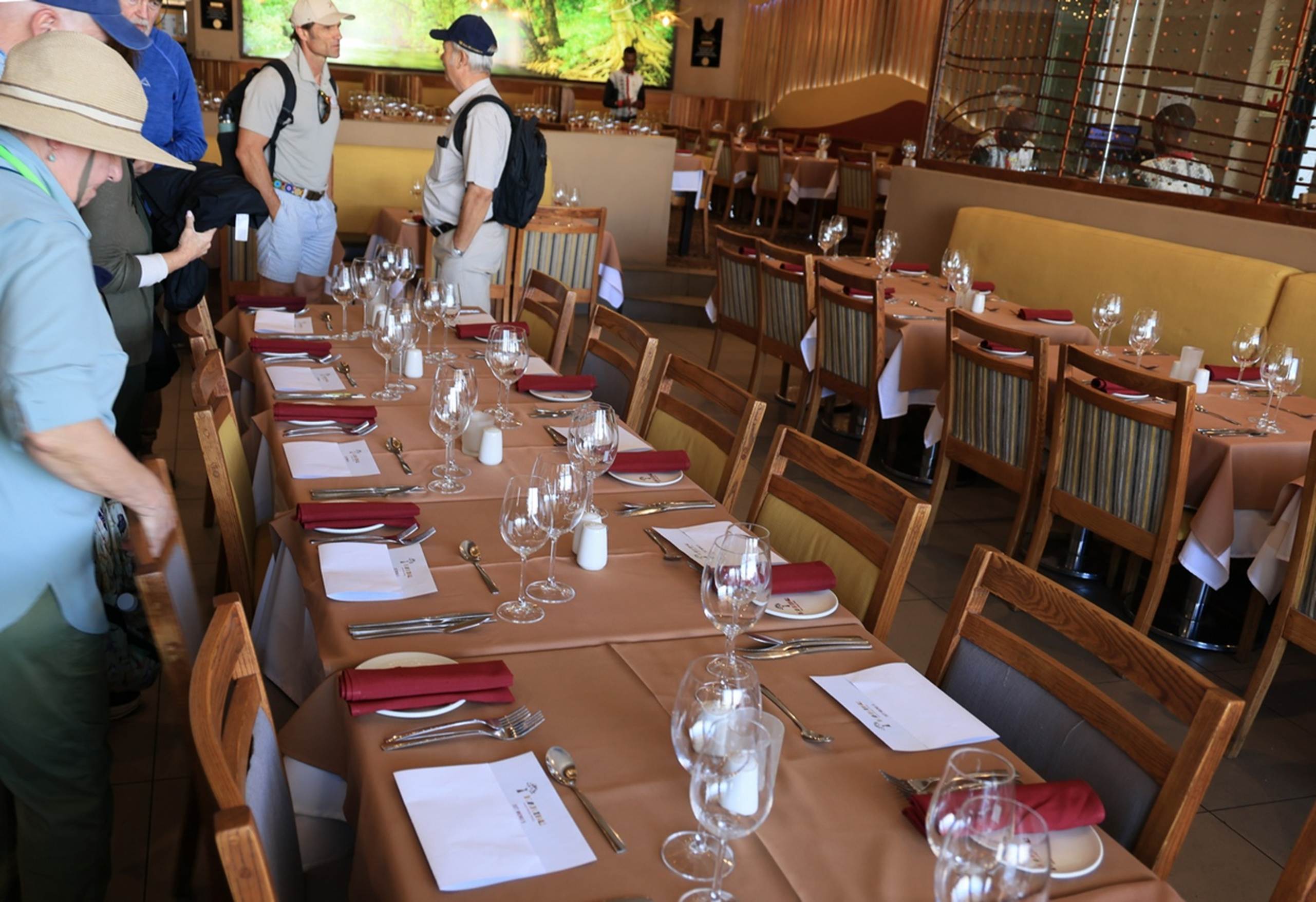
Kirsten and Christo talking before lunch
Our guide Kirsten, led us to a restaurant that was ready for us and we again had a very good and filling meal. From the restaurant we could see a lot of activity along the waterfront. The “pirate ship in the photo below was taking on a lot of passengers. There were also many other boat rides being offered along the length of the dock.

The Pirate Ship was busy (notice the mountain in the distance?)
We finished our late lunch about 3:00 and made our way back to the hotel, but not before purchasing one of Christo Brand’s books from him. I was having some problems with my directions in Cape Town and almost got us turned around, but just as I was afraid that we were going the wrong way, I looked up and realized our hotel was right in front of us.
Back at the hotel we rested for a little while and then decided we needed to take a walk and move around some, so we headed back to the wharf area. This was now Sunday evening and the place was hoping! Besides all the usual (and unusual) shops and restaurants, there were several street performers.

One of the unusual stores showing recycled artwork
One set of “street performers” was especially interesting: a group of young people lined up and taking turns doing some kind of semi-choregraphed dancing. Check this video and you’ll see what I mean. We continued to walk around for a while, crossing several pedestrian bridges that sometimes opened for boats going by. Check out this rotating bridge. Watch the bridge closely at the very end. The sailboats were heading out for a “Sunset Cruise”.
We wandered around for a while before heading back to our hotel and finding a small lounge in the basement where we ordered a couple of glasses of wine and some appetizers for supper.
Tomorrow, we head north to the Chobe River.
For a video summary (photos and videos in a “slide-show” format), check: https://www.youtube.com/watch?v=gij0LVbXEyc
You can either click on your “Back Button” to return to the main page, or click on this Chapter 2 to go directly to Chapter 2.